

Most local businesses get found the way they always have.
Someone needs a plumber, a roofer, a therapist, a dentist. They ask a friend, they type into a search box, or now, they ask an AI assistant.
What changed is how many places that question can go. And how little room each one leaves for businesses that haven't done the basics.
That's a problem for you if you run a local business. It's also an opportunity. The last official Canadian count1 found only 6% of small businesses used AI technologies at all, against 26% of large ones. Many of your competitors haven't adapted yet.
This guide covers all of it, in plain language: how Google and its map results pick businesses, how ChatGPT, Gemini, Perplexity and Copilot pick them, what you can control, and what you can't. Every number has a named source, a year, and a note when the research comes from a vendor that sells related services.
Let's start with the three things you need to know before you read anything else.
Three things to know first
1. Google still holds the majority. Statcounter2 puts Google at 89.94% of search engine traffic worldwide in September 2026. That figure counts search engines only, not chatbots. It tells you where traditional searching happens. It doesn't tell you where people are asking AI.
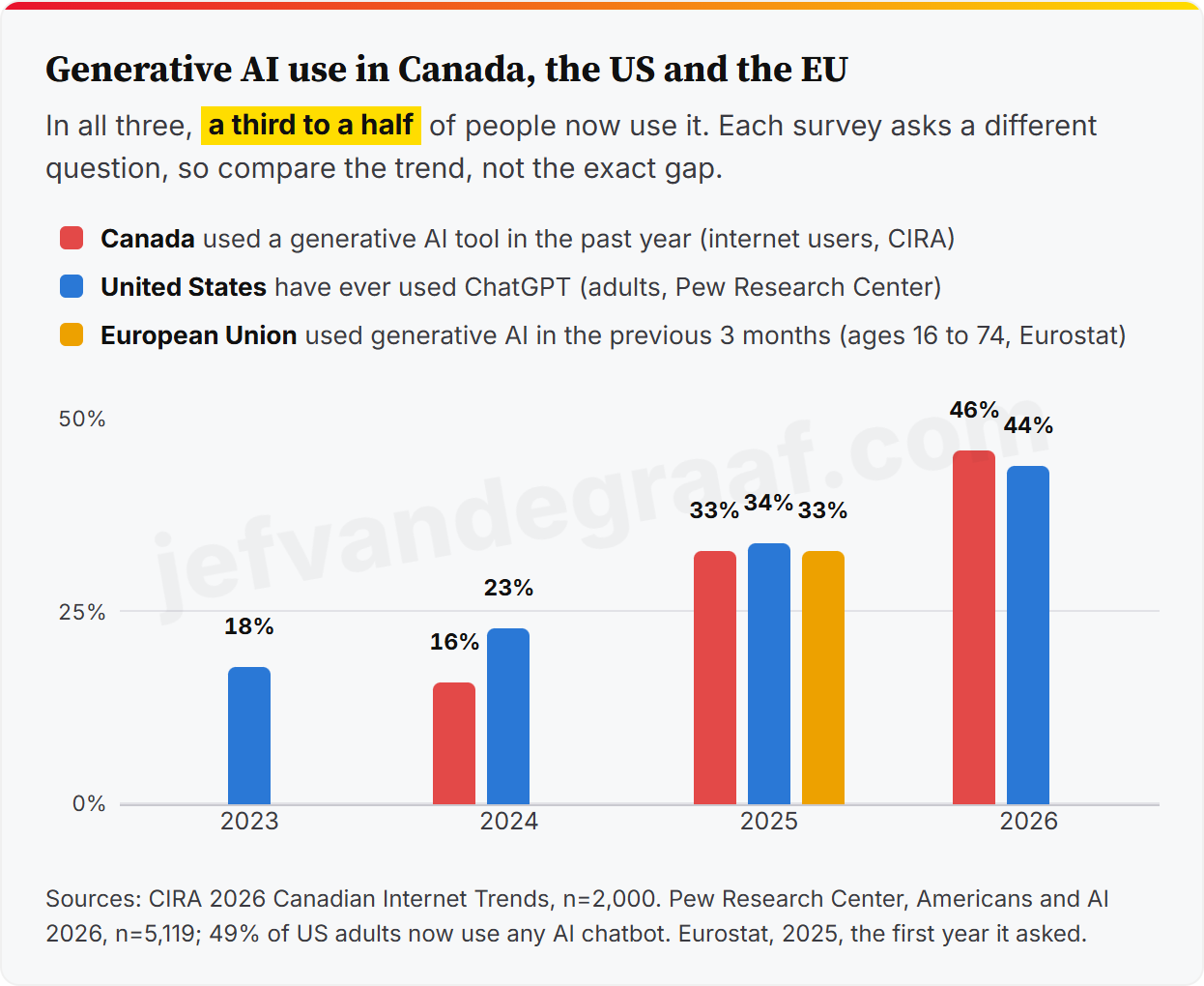
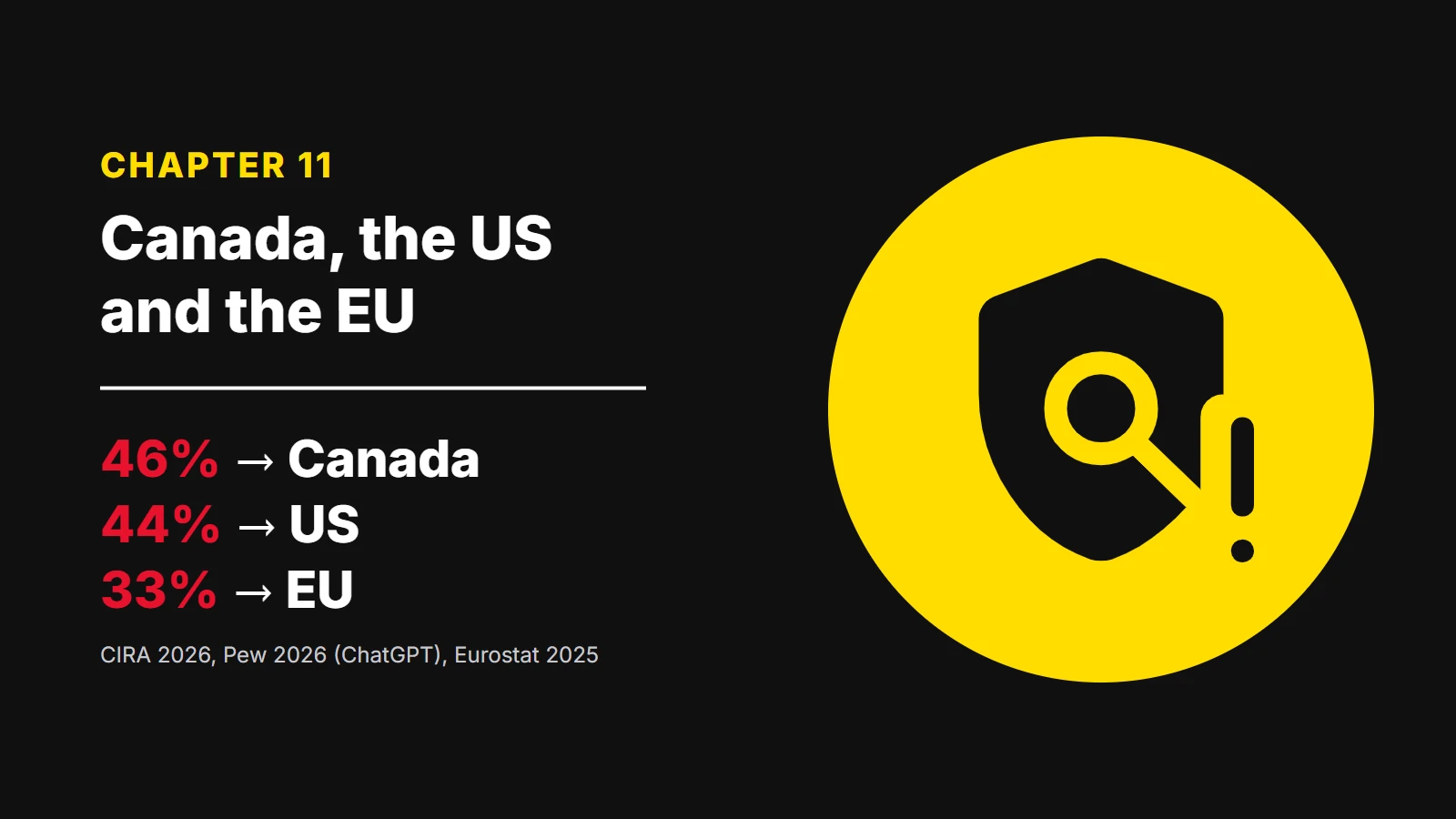
2. AI is a real second channel, and it's growing fast. In Canada, 46% of internet users used a generative AI tool in the past year, up from 33% in 2025 and 16% in 20243. In the US, 45% of consumers used AI tools for local business recommendations in the past year, up from 6% the year before4. In the EU, 33% of people aged 16 to 74 used generative AI in the previous three months of 2025, the first year Eurostat asked.5
Generative AI use in Canada, the US and the EU
In all three, a third to a half of people now use it. Each survey asks a different question, so compare the trend, not the exact gap.
- Canada used a generative AI tool in the past year (internet users, CIRA)
- United States have ever used ChatGPT (adults, Pew Research Center)
- European Union used generative AI in the previous 3 months (ages 16 to 74, Eurostat)
Sources: CIRA 2026 Canadian Internet Trends, n=2,000.3 Pew Research Center, Americans and AI 2026, n=5,119; 49% of US adults now use any AI chatbot.6 Eurostat, 2025, the first year it asked.5
Show the data
| Year | Canada | United States | European Union |
|---|---|---|---|
| 2023 | no data | 18% | no data |
| 2024 | 16% | 23% | no data |
| 2025 | 33% | 34% | 33% |
| 2026 | 46% | 44% | no data |
3. The work that wins in both places is mostly the same work. Google's own guidance on its AI features says optimizing for them is still SEO. For local businesses, that means an accurate Business Profile, a website that clearly says what you do and where, real reviews, and consistent information everywhere you're listed.
That's the whole guide in three lines. The rest is the detail, the evidence, and what to do about it.
How to read this guide
Each statistic comes with a source name and a year. I note when a sample is US-only, when it covers chain businesses instead of independents, and when the research comes from a company that sells local SEO software or services. A lot of numbers in circulation fail those tests, so near the end there's a list of bullshit statistics to avoid.
Each chapter follows the same pattern: what it is, why it matters in 2027, how it works, and what to do. Skip to the chapter you need. If you want the short version, jump to the checklist at the end. If you'd rather hand it off, that's what my local SEO service is for.
1. Where local search happens in 2027
Local search used to mean one thing: Google, and the three businesses on the map.
Now it's a loop between several places. Here's how to think about it.
What is local search?
Local search is any search where where you are matters. "Roofer near me." "Therapist Calgary." "Best thai restaurant open now." The search engine uses your location, or the place you name, to decide which businesses to show.
The three places people find you
In 2027, a local business can show up in three kinds of places:
- The map results. The "local pack" of three businesses with a map, plus Google Maps itself. Apple Maps and Bing Maps have their own versions.
- The regular results. Your website, ranked alongside everyone else's, in the usual list of links.
- AI answers. Google's AI Overviews and AI Mode, plus ChatGPT, Gemini, Perplexity, Microsoft Copilot and voice assistants, any of which can name a business directly.
You don't pick one. You need to be correct in all three, because customers move between them.
Why it matters: Google is still the centre, but not the whole picture
Here's the evidence on where people actually go.
- Google holds about 90% of search engine traffic.2
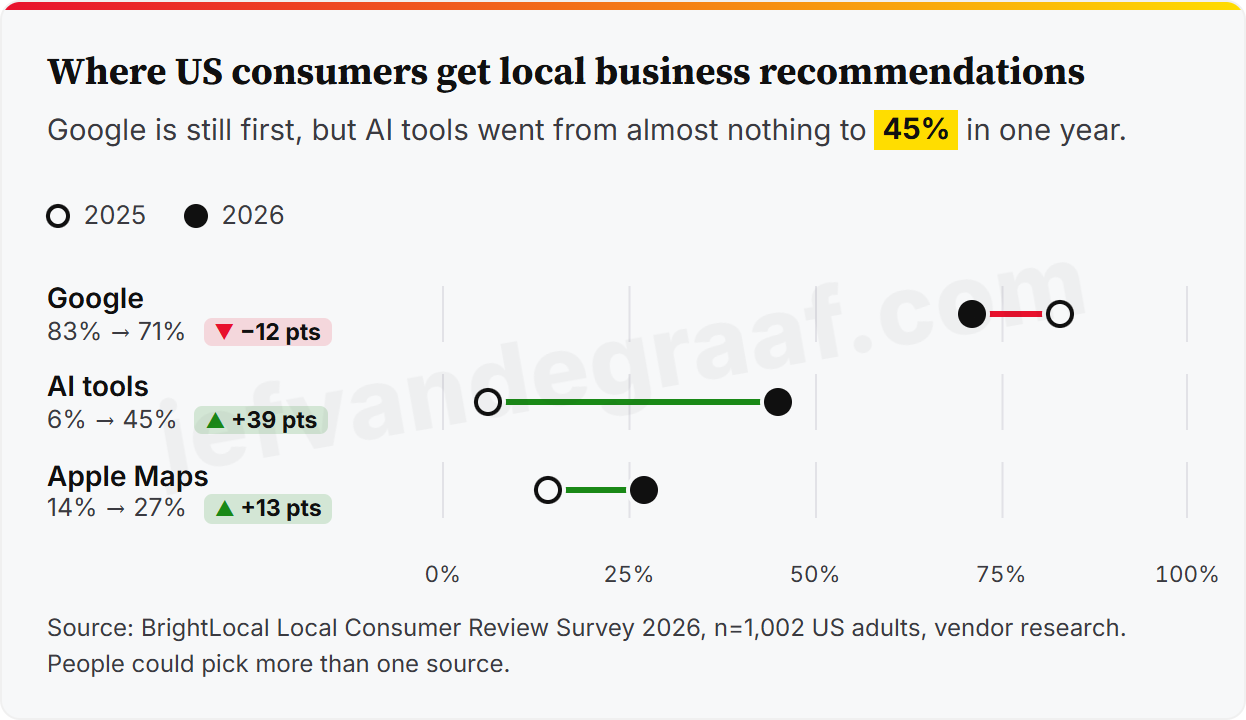
- For local recommendations in the US, Google fell from 83% to 71% in a year. Over the same period, AI tools rose from 6% to 45%, and Apple Maps nearly doubled from 14% to 27%4. Respondents can pick more than one source, so these numbers don't add to 100%.
- People aren't swapping search for AI. They're adding AI. SOCi's third annual consumer survey7 found search use for local business rose from 83% to 84%, while 52% had used an AI tool to find a local business in the past 30 days, up from 9% in 2025. Damian Rollison of SOCi said on the Near Media podcast that people aren't necessarily turning to AI instead of search, but in addition to it7.
Where US consumers get local business recommendations
Google is still first, but AI tools went from almost nothing to 45% in one year.
Google83% → 71% −12 pts
AI tools6% → 45% +39 pts
Apple Maps14% → 27% +13 pts
Source: BrightLocal Local Consumer Review Survey 2026, n=1,002 US adults, vendor research. People could pick more than one source.4
Show the data
| Source | 2025 | 2026 |
|---|---|---|
| 83% | 71% | |
| AI tools (ChatGPT and others) | 6% | 45% |
| Apple Maps | 14% | 27% |
Do people ask AI first, then check Google?
This is the question I get most, so I looked hard for the evidence. The honest answer is: partly, and nobody has measured it properly.
What we know:
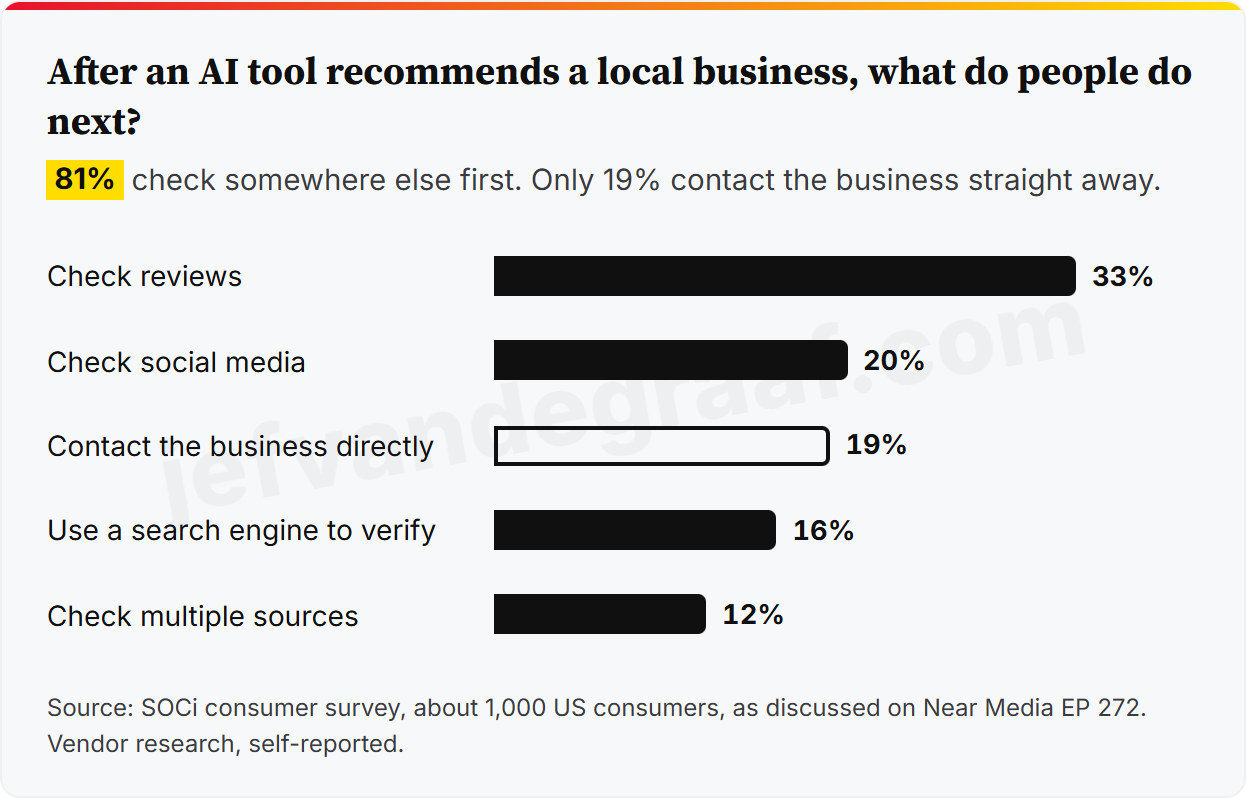
- Most people who use AI for local still check somewhere else before acting. In SOCi's survey, 81% would check before acting on an AI recommendation, and only 19% would contact the business directly. Where they'd check: reviews (33%), social media (20%), a search engine (16%), or several sources (12%).
- Yext's 2026 report8 found 53% would search Google or Bing after an AI recommendation, and 49% would visit the business's website.
- In Canada, 49% of AI users say they always or often verify AI answers. Only 19% always do3. That means about half the time, an AI answer about your business goes unchecked.
- Greg Sterling and Mike Blumenthal, who've covered local search for years, describe Google as the place people go after using AI, to see photos, read reviews and get directions and contact details7.
After an AI tool recommends a local business, what do people do next?
81% check somewhere else first. Only 19% contact the business straight away.
Source: SOCi consumer survey, about 1,000 US consumers, as discussed on Near Media EP 272. Vendor research, self-reported.7
Show the data
| What people would do next | Share |
|---|---|
| Check reviews | 33% |
| Check social media | 20% |
| Contact the business directly | 19% |
| Use a search engine to verify | 16% |
| Check multiple sources | 12% |
What we don't know:
- No one has published behavioural data (what people actually did, as opposed to what they said) showing the AI-then-Google sequence for local searches. The evidence is self-reported surveys, mostly from vendors.
- There's no Canadian data on this beyond CIRA's general AI figures.
- "AI first" isn't the majority behaviour yet. One Yext finding gets quoted a lot: at $150,000+ household income, 54.5% start local searches with AI. That's one income group, not everyone.
So here's the version I'd stand behind: most people who use AI to find a local business check somewhere else before they act, and Google (search, Maps and reviews) is one of the main places they check. I wouldn't say most people start with AI. The data doesn't support it.
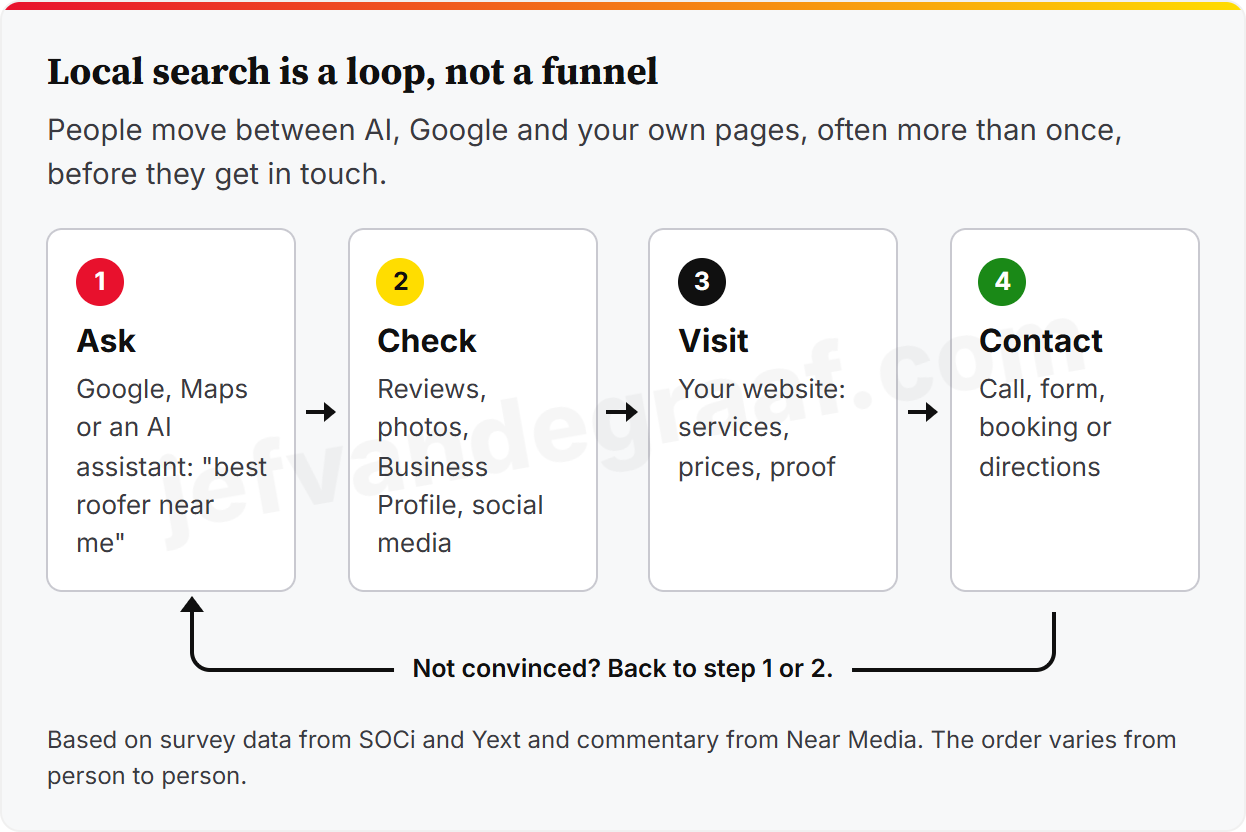
Local search is a loop, not a funnel
People move between AI, Google and your own pages, often more than once, before they get in touch.
- 1AskGoogle, Maps or an AI assistant: "best roofer near me"
- 2CheckReviews, photos, Business Profile, social media
- 3VisitYour website: services, prices, proof
- 4ContactCall, form, booking or directions
Not convinced? Back to step 1 or 2.
Based on survey data from SOCi and Yext and commentary from Near Media. The order varies from person to person.7,8
Google is also becoming the AI layer
Here's a wrinkle. "AI first, then Google" increasingly means "Google, then Google."
Google says AI Mode passed one billion monthly users in May 20269. But in the same period it handled only 0.34% of searches in the US, according to SparkToro and Similarweb10 (January to April 2026). Lots of people have tried it. Few use it for most searches.
And inside Google, local results are changing. Joy Hawkins of Sterling Sky reported on 21 September 2026 that AI-generated local packs show about 32% fewer unique businesses than the traditional pack, and many versions drop the click-to-call button11. That's a small sample, but it points at where Google is heading: fewer slots, more competition for each one.
Zero-click: the profile does the selling
In the first four months of 2026, 68.01% of Google searches ended without a click to any website10. Rand Fishkin, who published that study, also notes local businesses are one of the categories where SEO still pays off.
For local, zero-click often isn't a lost customer. The person saw your name, your rating and your phone number, and tapped call. But it does mean the result itself has to do more of the selling.
Pew Research found the same pattern from a different direction. When Google showed an AI summary, people clicked a regular result 8% of the time, versus 15% when there was no summary. Only 1% clicked a link inside the summary12. Google has disputed Pew's methodology, and the data covers all searches, not local ones specifically.
What you can do:
- Treat your Google Business Profile as your first website. For many searches it's the only thing a customer sees before deciding.
- Make every fact easy to verify. If people check your hours, address and reviews after an AI answer, those facts have to match everywhere.
- Check where you show up this week. Search your main service and city in Google, then in Maps, then ask ChatGPT, Gemini and Perplexity the same question. Write down who shows up and who doesn't. Chapter 8 walks you through this.
- Don't wait for perfect data. The research is thin on how AI affects local. The basics that win in Google also feed AI. Start there.
2. How AI picks local businesses (AEO and GEO, without the hype)
Two new acronyms have been selling a lot of services. Let's define them, then see what the evidence says.
What are AEO and GEO?
AEO (answer engine optimization) means shaping your content so AI and search tools can use it as the answer to a question.
GEO (generative engine optimization) means doing the same for tools that write answers from several sources, like ChatGPT, Gemini and Perplexity.
Both describe real behaviour. People do ask AI for recommendations, and AI does name businesses.
What does Google say?
Google published a guide to its generative AI features in May 2026 (updated July 2026). Its position is blunt: optimizing for generative AI search is optimizing for the search experience, and so it's still SEO13.
The same guide says:
- You don't need special schema markup or a machine-readable AI file to appear in AI Overviews or AI Mode.
- Google Search ignores llms.txt files. Making one neither helps nor harms your visibility in Google.
- Your pages have to be indexed and eligible to show with a snippet.
- For local, the one tool it names is Google Business Profile.
That's Google speaking about Google. It tells you nothing about how ChatGPT or Perplexity work. But it's good news for the small business owner who's been pitched an "AI visibility package."
Where AI assistants get local business information
Each assistant sources differently, and most don't publish exactly how. Here's what's documented and what isn't.
| Assistant | What we can verify | What we can't |
|---|---|---|
| Google AI Overviews and AI Mode | Google says no special optimization is needed and names Business Profile as the local lever. | Exactly how Business Profile data feeds AI answers. |
| Gemini | Google's developer tool for Gemini can ground answers in Google Maps data, covering more than 250 million places14. | That the consumer Gemini app uses it the same way. This describes the developer API. |
| ChatGPT | Yelp announced a licence to supply reviews and business details15. ChatGPT began showing local knowledge panels in December 2025. | Where those panels get their data. OpenAI doesn't document it. Barry Schwartz reported his own panel showed an address 20 years out of date.16 |
| Microsoft Copilot | Copilot's web search runs through Bing. Bing Places is Microsoft's business listing tool. | Microsoft doesn't say outright that Copilot's local answers come from Bing Places. |
| Siri and Apple Maps | Apple Business (the new name for Apple Business Connect) controls how you appear in Apple Maps, Siri and more. | Which outside data sources Apple Maps still uses. |
| Perplexity | Added Yelp data in 2024. | Current sourcing. Perplexity doesn't publish it. |
You'll see claims that ChatGPT "is mostly Bing." That wording comes from a 2024 BrightLocal study, not from OpenAI or Microsoft, so I wouldn't repeat it as fact.
What the evidence says about what matters
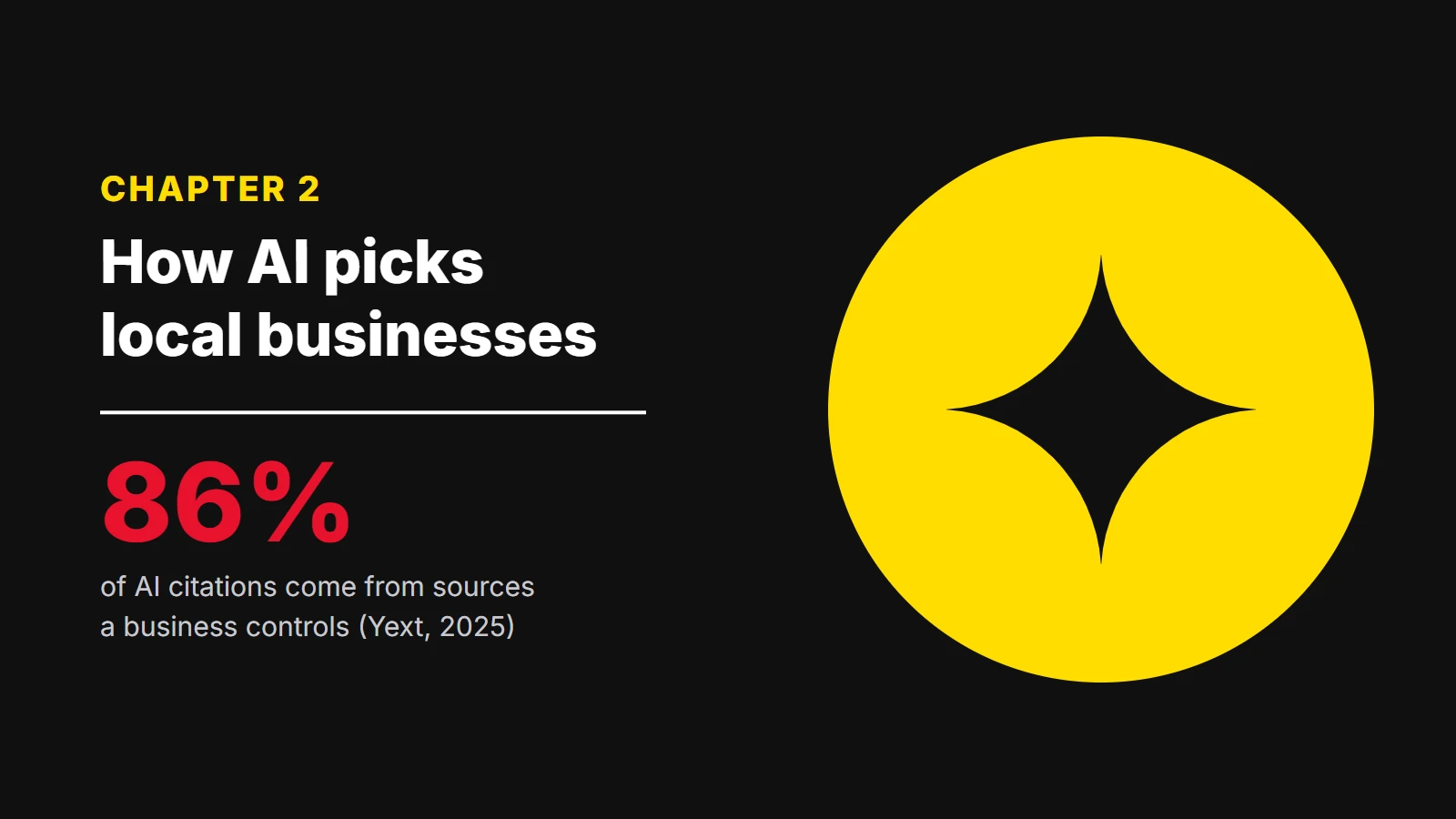
86% of AI citations come from sources a business controls. Yext analysed 6.8 million citations across ChatGPT, Gemini and Perplexity. Business websites were 44%, listings 42%, reviews and social 8%. Forums like Reddit were 2%17.
Mentions on other sites now matter more than classic directory listings. Whitespark's 2026 survey of 47 local SEO experts scored 187 ranking factors, and for the first time scored each for AI visibility. Darren Shaw, who runs it, summed up the finding in a phrase worth remembering: in AI SEO, mentions "are the new link."
The top five AI visibility factors in that survey:
- Expert-curated "best of" lists
- A dedicated page for each service
- Prominence on key industry websites
- Unstructured citations (news articles, blogs, industry associations)
- The authority of the third-party sites where your reviews appear
Three of those five are about being talked about elsewhere. And matching your name, address and phone number exactly everywhere, which used to be gospel, ranks 15th for the map results and 68th for AI visibility. Building hundreds of structured directory listings ranks 110th for the map results. This is expert opinion, not measured outcomes, and Whitespark sells local SEO services.
What AI gets wrong about local businesses
Here's the part most guides skip. AI gets business details wrong, often.
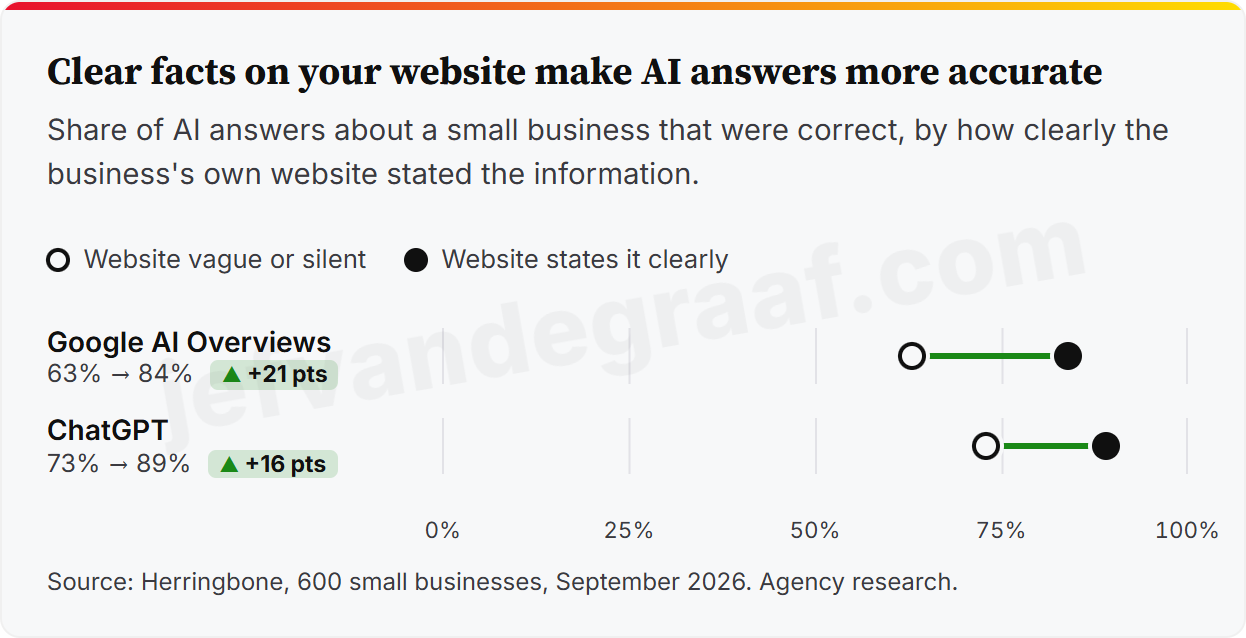
- Herringbone, an agency, tested 600 small businesses (dental, personal injury law and home services). 27% of Google AI Overview answers and 20% of ChatGPT answers contained incorrect information18.
- When the business had published the information clearly on its own website, accuracy rose to 84% for Google and 89% for ChatGPT. When the site was vague or silent, it fell to 63% and 73%.
- SOCi found ChatGPT and Perplexity were about 68% accurate on basic profile data, versus 100% for Gemini, which is grounded in Google Maps19.
- ChatGPT's local answers aren't stable. Spearleaf asked the same local questions 4 to 9 days apart in 18 US cities. Only 48.2% of the businesses ChatGPT showed the first time appeared again20.
Clear facts on your website make AI answers more accurate
Share of AI answers about a small business that were correct, by how clearly the business's own website stated the information.
Google AI Overviews63% → 84% +21 pts
ChatGPT73% → 89% +16 pts
Source: Herringbone, 600 small businesses, September 2026. Agency research.18
Show the data
| AI tool | Website vague or silent | Website states it clearly |
|---|---|---|
| Google AI Overviews | 63% correct | 84% correct |
| ChatGPT | 73% correct | 89% correct |
Put that together with CIRA's finding that only 19% of Canadian AI users always verify what AI tells them. A wrong phone number or wrong hours in an AI answer will often go unchallenged, and you'll never know it cost you a customer.
How hard is it to be named by AI?
Very. SOCi's 2026 Local Visibility Index looked at about 350,000 locations of multi-location brands. ChatGPT recommended 1.2% of locations, Perplexity 7.4% and Gemini 11%. By contrast, 35.9% of those brands appeared in Google's local 3-pack19. SOCi's own estimate, reported by Search Engine Land, is that a ChatGPT recommendation is up to 30 times harder to earn than a local pack spot.
Two cautions. These are chains, not independent shops. And the 35.9% figure measures how many brands appeared in the 3-pack, while the AI figures measure how many locations were recommended, so they aren't a perfect like-for-like. The direction is clear anyway: ranking in Google and being named by an AI assistant are two different things.
The locations ChatGPT did recommend averaged 4.3 stars. SOCi describes ratings as working more like a gate than a ranking factor. Below a certain level, you don't get in the conversation.
Myth box: things you don't need
Based on Google's guidance and the evidence above, you don't need:
- An llms.txt file. Google Search ignores it. Whether other assistants read it isn't established. One wrinkle: Lighthouse now has an optional llms.txt audit for AI agents,21 so it's worth watching. It still isn't a ranking factor.
- Special "AI schema." There isn't any.
- To chop your pages into tiny chunks for AI. Google lists this as unnecessary.
- A separate page for every possible variation of a question. Google says producing those at scale violates its spam policy on scaled content.
- Anyone's "AI visibility package" priced like magic. The fixes are mostly basics, and chapters 3 to 7 cover them.
John Mueller of Google has warned that the more urgency and the more new acronyms someone pushes, the more likely it is spam or a scam22.
What you can do:
- Publish your facts plainly on your own website. Hours, address, phone, services, service areas, prices or price ranges. The Herringbone result suggests clear information is worth about 20 points of accuracy.
- Keep every listing identical. Business Profile, Apple Business, Bing Places, Facebook, your website. One master record, copied everywhere.
- Earn mentions, not just listings. A local news story, a trade association page, a "best of" list in your city, a supplier's "where to buy" page.
- Check what AI says about you every quarter. Ask ChatGPT, Gemini, Perplexity and Copilot about your business. Write down anything wrong. Fix the source, then check again. I go deeper on why ChatGPT recommends your competitors in a separate post.
- Don't buy a package that promises to "rank you in ChatGPT." Nobody can promise that, and the evidence says it's unstable even for businesses that were shown once.
Example: Say you're a plumber in Winnipeg. You ask ChatGPT, "Who's a good emergency plumber near me?" and your business isn't named. Instead of guessing, you check four things: Does your Business Profile show the right hours? Does your website have a page that says "emergency plumbing in Winnipeg" with your phone number? Are you listed on the same sites as the plumbers who were named? Do you have reviews on those sites? Almost every gap you find is one of those four. Fix them, wait a few weeks, and ask again.
3. Your Google Business Profile
If you only do one thing from this guide, do this.
What is a Google Business Profile?
A Google Business Profile (GBP) is the free listing that shows your business in Google Search and Google Maps: name, address, phone, hours, photos, reviews, services and a link to your website. You claim it, verify it, and manage it yourself.
Why it matters in 2027
Three reasons.
- It's the main lever for the map results. Google says local results rest mainly on relevance, distance and prominence, and prominence depends on things like how many reviews you have and how many sites link to you23.
- It's the one local lever Google names for its AI features. In its AI guide, Google says tools like Business Profile can help local businesses be visible in both AI responses and regular results13.
- It does the selling when nobody clicks. With zero-click searches at 68% in 2026 and the click-to-call button being removed from some AI local packs, the profile is often the only thing a customer sees before deciding.
What practitioners say matters most
Whitespark's 2026 survey24 put these at the top for the map results:
- Your primary Business Profile category
- Distance from the searcher
- Keywords in the business name
- A physical address in the city being searched
- Being open at the time of the search
For the factors you can actually work on, see my post on local SEO ranking factors.
Look at number 3 carefully. Don't do it. Adding keywords that aren't part of your real name breaks Google's rules and risks suspension. More on that below.
Number 5 is new this year. "Business is open at time of search" entered the survey at number 5, and having proper hours set on your profile jumped 64 places to number 21.
The rules that get profiles suspended
Google's guidelines are specific25:
- Name. Use the real name on your sign and stationery. No taglines, no phone numbers, no URLs, no extra location words.
- Address. P.O. boxes and mailbox services aren't valid. Virtual offices and unstaffed co-working desks aren't either.
- Service-area businesses. If you travel to customers, you can hide your address and list the areas you serve. Google's guidance is that the area shouldn't stretch beyond about two hours' drive from your base.
- Categories. Use the fewest that describe what you actually are. Google's test: "this business is a ..." not "this business has a ..."
- Hours. Real, customer-facing hours.
Whitespark's 2026 survey also flagged new things that hurt or get profiles suspended: stuffing keywords into the description, using AI-generated text or AI-generated photos on the profile, and setting service areas bigger than a two-hour drive. If you're not sure whether your description reads as AI-written, here are 32 signs of AI writing.
If you do get suspended, Google's process is an appeal with evidence26. Business registration, licence, tax documents or a utility bill help, and the name and address on those documents have to match your profile exactly. Don't create a duplicate profile while the appeal is pending. EU-based businesses can request an additional review if the first appeal is denied.
What you can do:
- Name it exactly as the sign reads. If your legal name and your trade name differ, use the one customers see.
- Pick one primary category and add secondary categories only for services you truly provide. Look at the three businesses in your map results for your main search and see which categories they use.
- Set accurate hours, including holidays. Don't list hours you don't keep. It frustrates customers and breaks Google's guidelines.
- Fill in services and descriptions in plain language. Write like a person. No keyword lists.
- Use real photos. Not AI-generated ones.
- Keep a "proof folder" with your registration, licence and a recent utility bill that match your profile name and address. If you're ever suspended, you'll have it ready.
- Check the profile every month. Make sure the hours, phone number and address Google shows are still the ones you set.
Watch list
Google launched Ask Maps, a conversational search inside Google Maps, on 12 March 2026 in the US and India27. On 6 August 2026 Google began rolling it out in Canada, Australia, Brazil, Indonesia, Japan, Mexico and over 150 other countries and territories in English28. Features like ordering food or checking hotel prices start in the US. Business Profile is the data behind it either way.
4. Listings, citations and mentions
Your Business Profile is one listing. There are dozens more.
What is a citation?
A citation is any mention of your business's name, address and phone number (together called NAP) on another website. Directories, social profiles, trade association pages, local news articles, supplier "where to buy" pages. Some are structured, like a directory entry. Some are unstructured, like a newspaper article that names you.
Why it matters in 2027
It's changed. The old advice was: build as many listings as you can and make the NAP identical everywhere. That's still reasonable hygiene. But the evidence says it's no longer the main event.
- Matching your NAP exactly ranks 15th of 187 factors for the map results and 68th for AI visibility. Quantity of structured citations ranks 110th for the map results24.
- Unstructured mentions (articles, blogs, industry association pages) and "best of" lists sit near the top of the AI visibility factors in the same survey.
- Three of the top five AI visibility factors are about being mentioned elsewhere. Darren Shaw's takeaway: citations are back, but the kind that matters now looks more like press coverage than directory entries.
Old statistics on this topic are mostly from 2018, so I'd skip them. The widely circulated claims that consistent NAP makes you "40% more likely" to appear in the local pack or "3.2 positions" higher have no original study behind them that I could find.
The core listings, for Canada
Whitespark publishes a Canadian shortlist of 35 sources. The top five, in its order, are: Google Business Profile, Apple Maps, Bing Places, Facebook and Yellowpages.ca. Yelp, Foursquare and MapQuest come next29. The page is undated and still lists a data provider that appears defunct, so treat it as a starting shortlist, not measured data.
The Better Business Bureau sits near the bottom of that list (34 of 35). For most service businesses it's a trust badge more than a ranking tool.
Two platforms changed this year, and many guides haven't caught up:
- Apple Business replaced Apple Business Connect. Apple announced the change on 24 March 2026, and Apple Business launched on 14 April 2026 in 200+ countries and regions. It's free. Existing Business Connect data migrated automatically. It controls how your place card looks in Apple Maps, Safari, Spotlight and Siri. Brand and Location Management is listed as available in Canada, the US and named EU countries30.
- Bing Places moved from bingplaces.com to bing.com/forbusiness in October 2025, with an easier import from your Google profile31. Microsoft says it's available in select markets, so confirm your country is supported. It matters because Microsoft Copilot searches through Bing. While you're there, submit your site to Bing Webmaster Tools.
Industry directories
Which directories matter depends on your trade. For therapists, Yext found healthcare was the industry where listings drove the largest share of AI citations: 52.6%17. That points at Psychology Today and your provincial or state association directory, not at generic directories.
For trades, look at where your competitors who appear in AI answers are listed. I'll cover that audit in chapter 8.
What you can do:
- Create one master record. A single document with your exact business name, address, phone, hours, website, categories and a short description. Copy from it, never retype.
- Claim the big four first: Google Business Profile, Apple Business, Bing Places and Facebook.
- Add your trade's own directories, and your local chamber of commerce or business association. For Canada, start with my list of Canadian business directories.
- Pursue mentions that read like a real endorsement: a local news story, a supplier or manufacturer page that lists you as an installer, a "best of" list in your city, a partner's website.
- Audit annually. Search your phone number in quotes. Search your name plus your city. Fix the old address, the old number, the closed duplicate.
- Don't pay for 200 directory listings. The evidence says the quantity of structured citations barely moves the map results.
Example: You move your shop two blocks. You update your Business Profile and website, but your old address still shows on Yellowpages.ca, Facebook and in a 2022 newspaper article. A customer checks your profile after asking an AI, sees the new address, then sees the old one on Facebook, and doesn't know which is right. You can't edit the newspaper article. But you can ask the editor to add a correction note, and you can fix the other two in ten minutes. That's what an audit finds.
5. Reviews
Reviews are the part of local search you can't fake, and the part customers read hardest.
What are reviews, as far as search goes?
Reviews are the ratings and written comments customers leave on your Google profile and on other sites. They do two jobs. They help Google decide who ranks, and they help people decide who to call.
In 2027 they do a third job: AI tools read them, summarize them and quote from them.
Why it matters: the bar keeps rising
BrightLocal's 2026 consumer survey4 shows how quickly expectations have moved in one year:
- 31% of consumers will only use a business rated 4.5 stars or higher, up from 17% the year before.
- 68% require at least 4 stars, up from 55%.
- 47% won't use a business with fewer than 20 reviews.
- 74% only care about reviews from the last three months.
- 97% read reviews when choosing a local business.
The samples are American, so the exact figures may differ in Canada. But a similar jump in 2026 across several measures suggests the direction is the same.
Reviews now feed AI
- 82% of US consumers read AI-generated review summaries, like the ones shown above Google reviews, and 23% say they'd rely on the summary alone4. So the themes that recur in your reviews matter, not only the star count.
- ChatGPT-recommended locations averaged 4.3 stars in SOCi's index. SOCi calls reviews more of a gate than a ranking signal for AI.
- Reviews send people to your website. 54% of consumers go on to check a business's website after reading positive reviews, up from 32% in 20194. In Canada, your website matters too; see chapter 6.
Replying matters
- 89% of consumers expect owners to respond to reviews.
- 50% are put off by templated or generic replies.
- 19% expect a same-day response, up from 6% the year before.
There's academic support, too. A peer-reviewed experiment on how people chose physicians found a higher share of negative reviews reduced the intention to choose a doctor, while a physician's response to reviews had a positive effect32. Participants were in China and the setting was medical, so treat it as supporting evidence, not proof for your trade.
The rules for asking
This is where owners get in trouble. Asking is fine. Asking selectively or paying for it is not.
Google. Reminding customers to review is allowed, including with a link or QR code. Google prohibits offering incentives such as discounts or free goods or services for reviews. It also prohibits selectively soliciting positive reviews, which covers review gating: sending happy customers to Google and unhappy ones to a private form33,34. Send the same request to everyone.
Canada. Three things to know:
- CASL applies to commercial emails and texts. You need consent (express, or implied from a purchase in the last two years), your identification, and an unsubscribe that works within 10 business days. Penalties for the most serious violations reach $1 million for individuals and $10 million for businesses35. No regulator has said whether a message that only asks for a review counts as a commercial message, so build your request to meet the rules and treat it that way.
- The Competition Bureau says businesses can be liable for fake or misleading reviews, including reviews posted by their own employees without disclosure36. Use client testimonials only with prior written permission, and don't change what they said.
- Drip pricing. Mandatory fees added after the advertised price (booking, service, admin, call-out) can be misleading. Show the all-in price, excluding sales tax37.
United States. The FTC's rule on consumer reviews took effect on 21 October 2024. It bans fake or AI-generated reviews that misrepresent a real experience, buying reviews with a set sentiment, undisclosed insider reviews and review suppression. Asking all customers is allowed38.
European Union. Since 28 May 2022, traders may not submit or commission fake reviews or claim reviews come from real customers without checking. If your site shows reviews, say how you check them39.
This is information, not legal advice.
A warning for therapists and psychologists
Standard advice says to ask every customer for a review. For regulated professionals, that can create a professional conduct problem, and the rules differ by regulator:
- Alberta. The College of Alberta Psychologists' 2024 guideline says psychologists may not seek positive reviews or ask for testimonials. It suggests a confidential feedback survey instead40.
- Ontario. The College of Psychologists and Behaviour Analysts' 2024 standards say testimonials may not be used to promote a practice41.
- British Columbia. The successor regulator's practice checklists cite a standard against using client testimonials. Check the current wording with the College of Health and Care Professionals of BC directly.
- Quebec. The Ordre des psychologues allows unsolicited testimonials within limits, but not soliciting them42.
- United States. APA Ethics Code standard 5.05 bars soliciting testimonials from current therapy clients or others vulnerable to undue influence. A draft revision circulated in December 2024 reportedly widens it. Check the current text at apa.org.
Counsellors, social workers and marriage and family therapists have their own regulators. Check yours before you send a single review request. For therapists, put the effort into accurate listings, complete directory profiles (Psychology Today and your association) and clear website content instead.
What you can do:
- Ask everyone, the same way, after the job. A short message with a direct link or QR code to your Google profile. You can copy my review request templates.
- Keep it steady. 74% of people only care about the last three months, so one big push once a year doesn't work.
- Reply to every review in your own words, within a few days. Thank people for specifics. For negative ones, be brief, own what you can, and take the details offline.
- Never offer a discount, gift or draw for a review. Never write your own, or let staff or family.
- Read your reviews for patterns. If the same complaint shows up three times, an AI summary will repeat it to everyone.
- Aim for 20 or more reviews and a rating near 4.5. Those are the thresholds many consumers say they use.
Example (illustrative numbers, not a benchmark): Say you complete 40 jobs a month and have 12 reviews. If you ask all 40 customers and, say, one in five leaves a review, that's 8 new reviews a month. In month one you pass 20. By month three, you'd have around 24 reviews written in the last three months, which is the stock the 74% of customers care about. If you only ask on the days you feel like it and half your customers never hear from you, those numbers halve and you'll still be under 20 reviews after three months. Your own response rate will differ. Measure it for three months and plan from your own number.
6. Your website
Your Business Profile gets people to the door. Your website decides whether they walk in.
Is a website still necessary?
Yes. Canadian data says so, and so does what people do after they read your reviews. (More on why your business needs a website.)
- 61% of Canadian internet users agree a website makes a business look more credible, 59% say they're more likely to do business with a company that has one, and 34% say they don't trust businesses without one3. CIRA has tracked this every year since 2016.
- 54% of US consumers visit a business's website after reading positive reviews, up from 32% in 20194.
- In the EU, 79% of enterprises with 10 or more employees had a website in 202543. A website is expected. What matters is what it says.
So the question isn't whether to have one. It's whether yours answers the questions people have after they find you.
What the research says to put on it
One page for each service. In Whitespark's 2026 survey, a dedicated page for each service was the number one factor for regular local results, followed by city or neighbourhood relevance in the page content24. It also ranks second for AI visibility.
Clear facts, stated plainly. The Herringbone study found AI answered correctly far more often when the business's own website stated the information clearly. Put your hours, address, phone, service areas, prices or price ranges and your licence or registration details where people (and machines) can read them without clicking.
Original content, not copies. Google's AI guide says to create content that isn't a commodity: first-hand, specific, useful. It also says generating separate pages for every variation of a question at scale violates its scaled content abuse policy. One strong page for "emergency roof repair in Saskatoon" beats forty near-identical pages.
Roughly the right length. Unbounce's 2024 benchmark44 found conversions peaked for commercial and professional services landing pages between 275 and 745 words. That's landing pages, not every page, but it's a useful check against both thin pages and walls of text.
Local proof. Where you work, who you've worked for (with permission), photos from real jobs, your licence and insurance, your reviews.
Your Canadian ownership, if true. 65% of Canadian online shoppers prefer to buy from Canadian businesses when they have the choice. More than half of them cite supporting the Canadian economy or local businesses as the main reason3. That research measures online shopping, not services specifically, but it's cheap to say plainly if it's true.
Speed and mobile
Core Web Vitals are Google's page experience measures. Google's "good" thresholds are: main content loaded within 2.5 seconds, interaction response under 200 milliseconds, and layout shift below 0.1, measured at the 75th percentile of visits45.
In July 2025, 48% of mobile sites and 56% of desktop sites passed all three46.
Google uses these in ranking, but says it always seeks to show the most relevant content even if the page experience is poor47. So speed won't rescue an irrelevant page. It stops a relevant one from losing the customer.
On that point, Deloitte and Google measured it. A 0.1-second improvement in mobile site speed reduced bounce rates on lead generation pages by 8.3%48.
Is mobile still the main thing? Less than you'd think. Statcounter's July to September 2026 data shows desktop at 53.89% of page views in Canada and mobile at 43.26% (page views on Statcounter-tracked sites, not searches)49. In Unbounce's data for commercial and professional services, about four in five visits to landing pages were mobile, and mobile converted 40% lower than desktop. I couldn't find a credible primary source for the share of local searches done on mobile. So build for both, and check your own analytics.
Structured data: useful, not magic
Google documents LocalBusiness structured data as a way to tell it about your hours, address and phone. It says features that use structured data aren't guaranteed to show50. Whitespark's experts rank schema 161st of 187 for the map results and 44th for AI visibility. Add it if your site builder makes it easy. Don't pay extra for it.
Rules for your website
- Privacy notice next to every form. In Canada, PIPEDA expects you to say what you collect, why and who to contact. Quebec's Law 25 adds a published privacy policy and a named person responsible. In the EU, GDPR requires a notice and a lawful basis, and a pre-ticked marketing box doesn't count as consent. Not sure which pages you need? See website legal pages.
- French in Quebec. If you operate in Quebec, the Charter of the French Language expects a complete French version of your website, and French clearly predominant in advertising51. A partial French page isn't a French page.
- Accessibility in the EU. Since 28 June 2025 the European Accessibility Act has required consumer-facing e-commerce services to meet accessibility requirements, with an exemption for service microenterprises under 10 employees and €2 million turnover. Rules vary by country. This is information, not legal advice.
Keeping it up
Here's the problem most owners hit. Small Business Majority's 2023 survey52 found 56% of owners maintain their website themselves, 73% say finding time for it is a challenge, and 68% say keeping content current is a challenge. About three in ten had no website at all.
A site that was right at launch and wrong two years later is a liability. Your hours change. Your services change. If your Business Profile says one thing and your website another, an AI assistant has two stories to choose from. A post-launch checklist helps you keep it current.
What you can do:
- Build one page per service and per main area you serve. Write each for the actual service in the actual place, with real details. Don't clone pages and swap the city name.
- Put your facts in plain text. Not only in images or PDFs.
- Show your licence, insurance and real job photos.
- Test it on a phone and on a laptop. Run Google's PageSpeed Insights on your top three pages and fix what it flags. Here are a few more free web audit tools.
- Add a privacy notice next to every form.
- Put a calendar reminder to review the site every quarter. Hours, prices, services, team, phone numbers, the date on your privacy policy.
Example: A roofing company serves Saskatoon, Warman and Martensville and does three jobs: repairs, full replacements and storm damage. A sensible structure is three service pages, each written for that job, plus one page each for the three areas that describe real jobs done there. That's six pages. It isn't 3 × 3 = 9 near-copies. Each page has its own photos, its own answers to the questions people ask, and the same footer with the same name, address and phone.
7. From search to enquiry

Getting found is half the job. The other half is what happens in the next five minutes.
What happens after someone finds you?
They call, message, book, or fill in a form. Or they don't, and they move on to the next business on the list.
Why it matters: speed
The most-quoted lead response statistic in marketing is usually credited to Harvard Business Review. It's actually from MIT Sloan professor Dr James Oldroyd and InsideSales.com, in 2007. The study covered six companies, more than 15,000 leads and over 100,000 call attempts.
It found the odds of contacting a web-generated lead dropped 100 times when the call was made at 30 minutes instead of 5 minutes. The odds of qualifying that lead dropped 21 times53. It's 2007 data on web-generated sales leads at six companies, so don't apply the multiples to a leaking tap. But the direction has held up: the faster you respond, the more likely you are to talk to the person at all.
Customers expect it from reviews too. 19% now expect a same-day response to a review, up from 6%4.
Make the next step easy
The best evidence on forms comes from government behavioural science and academic experiments, not from blogs.
- Ask the easy question first. Presenting a multiple-choice question before an open-ended one raised completion from 84% to 89% across 25,000+ surveys. Cutting open-ended questions from ten to one raised completion from 78% to 88%54. For a quote form, that means checkboxes for the type of job, then one open box at the end, not "Tell us about your project" at the top.
- Don't understate the effort. Completion of a 30-minute survey fell from 47% to 28% when people were wrongly told it took 10 minutes (same source). If your form says "takes 30 seconds," make it true.
- Fewer fields isn't always better. In a controlled test, removing side navigation and extra calls to action beat the control by 87% and 109% in lead rate, and one winner added four fields. Page focus mattered more than field count55. I cover when long forms make sense separately.
- Every extra prompt costs. In a classic experiment, removing a discount-code field from a checkout lifted conversion by 6.5% because it made people pause and wonder if they were overpaying56. Any field that sends someone off to compare is a risk.
Test big changes, not tiny ones
A plumber with 2,000 visits a month can't meaningfully A/B test button colours. To detect a 5% relative change on a page that converts 5% of visitors, you'd need roughly 500,000 users. To detect a 20% change, about 30,40056. Microsoft found only about a third of ideas it tested improved the metric they were meant to improve57. For a small site: make large changes (a clearer page, a faster phone number, a shorter form), then compare months, not days.
Paid placement: Local Services Ads and Google Ads
For some trades, a paid unit sits above the map results.
- Local Services Ads charge per valid lead (a call or message), not per click. They require screening and verification, and Google now calls the badge "Google Verified." Availability varies by country and category. Whitespark's experts rank budget and bidding, reviews, service selection and response times as the top four placement factors.
- They're changing. Google says Local Services Ads accounts outside the US move to Performance Max campaigns with pay-per-lead goals through 2027, with reports not carrying over. If you use them, download your reports before you're migrated, and keep your Business Profile current, because the new campaigns pull from it58.
- Google Ads costs are rising. WordStream's 2025 benchmarks59 put the average cost per lead at $70.11, up from $66.69, with the average conversion rate at 7.52%. By vertical: Physicians and Surgeons 11.62%, Personal Services 9.74%, Dentists 9.08%, Home and Home Improvement 7.33%.
Paid and organic work together. Both depend on the same reviews and the same profile.
What you can do:
- Decide who answers, and how fast. Write down: who picks up the phone, who checks the form inbox, and by when. A same-day reply as a minimum, five minutes for calls where you can.
- Make the phone number tappable and visible without scrolling on a phone.
- Shorten your form. Easy questions first, one open box at the end, a privacy line, and an honest time claim. Here are 37 reasons contact forms don't convert.
- Tell people what happens next. "We'll call you within two hours" beats a blank thank-you page. Pair it with a clear call to action.
- Track missed calls. A call you didn't answer is a lead you paid to attract.
Example: Say your Business Profile shows 100 call-button clicks in a month and you answer 70 of those calls. Even if you win half the ones you answer, that's 35 jobs. Answer 85 instead, with a missed-call text back, and at the same win rate you have 42 or 43 jobs, without a single extra visitor. (Illustrative numbers. Google counts clicks on the call button, not answered calls.)
8. Your AI visibility audit
Before you fix anything, find out what AI says about you today. It takes about an hour, and it's more useful than any dashboard.
What is an AI visibility audit?
It's a structured way of asking AI assistants the questions your customers ask, and recording what comes back about you and your competitors.
Why it matters
AI answers are unstable. Spearleaf's August 2026 study found only 48.2% of businesses ChatGPT showed were shown again when the same questions were asked 4 to 9 days later. Google's local pack was far more stable. So a single check proves little. Ask more than once.
And accuracy is a problem. Herringbone found 27% of Google AI Overview answers and 20% of ChatGPT answers about small businesses contained incorrect information. You can't fix what you haven't seen.
How to run it
Step 1. Write 10 questions your customers would ask. Use plain language. Include your service and city, a "near me" version, an "open now" version and a price question. For example:
- "Who is a good emergency plumber in [city]?"
- "Best [your service] near [neighbourhood]?"
- "Who does [your service] in [city] and is open on Sunday?"
- "How much does [your service] cost in [city]?"
- "Is [your business name] any good?"
Step 2. Ask each question in four places. ChatGPT, Gemini, Perplexity and Microsoft Copilot. Also run the search in Google and look at the map results and any AI Overview.
Step 3. Record what you see. Make a simple table.
| Question | Tool | Named? | Position | Details right? | Who else was named | Source cited |
|---|---|---|---|---|---|---|
| Emergency plumber in [city] | ChatGPT | No | n/a | n/a | Business A, Business B | Yelp |
Step 4. Check the facts. For every time you're named: hours, phone, address, services, prices. Mark each right or wrong.
Step 5. Look at the winners. Where are the businesses named instead of you listed? What are their ratings and review counts? Which sites do the tools cite?
Step 6. Fix the source, not the tool. You can't edit ChatGPT. You can edit your Business Profile, your website, Apple Business, Bing Places and the directory a tool cited. Then check again in a few weeks.
Step 7. Repeat monthly for three months, then quarterly. Run each question twice, a few days apart.
What patterns to look for
- You're not named, and the winners have far more reviews. Chapter 5.
- You're named with wrong details. Chapters 3, 4 and 6: conflicting listings, or vague website text.
- You're named, but not for the service you want. Your service pages are too thin or your primary category is wrong.
- A competitor is named because of a "best of" list or a news article. Chapter 4: get mentioned.
- Nobody local is named. There may be room for the business with the clearest, most factual pages.
What you can do:
- Use a new chat each time, so earlier answers don't colour later ones.
- Take screenshots with dates. They're your evidence when you fix something.
- Don't chase a single answer. Look for the pattern over several runs.
- Keep your list of questions fixed so you can compare month to month.
9. Measuring what's working
Local search measurement is full of gaps. Here's what you can see, what you can't, and the cheap habits that fill some of the gaps.
What Google Business Profile can tell you
Google's own definitions60 are more limited than most owners assume:
- Calls counts clicks on the call button. It doesn't count answered calls or tell you whether a call became a job.
- Bookings counts only bookings made through a booking provider linked to your profile.
- Views counts unique visitors per day, and only views of your profile, not every time your business is seen on Google.
- Directions counts requests for directions, not visits.
- Searches updates monthly and shows search terms you can't directly manage.
- Organic and Google Ads data are combined, so you can't split them.
None of these show whether an AI answer mentioned you.
What Google Analytics and Search Console can tell you
- Google Analytics now has an "AI Assistant" channel (added 13 May 2026). It groups visits from ChatGPT, Gemini, Copilot, Grok and similar assistants. It excludes Google's AI Overviews and AI Mode, which show up as ordinary Google organic traffic61.
- Prefer something simpler? I use Fathom Analytics, a privacy-first alternative. It's simpler, but it doesn't link to your Business Profile the way Google Analytics does.
- ChatGPT tags its links with utm_source=chatgpt.com, according to OpenAI62, so visits from ChatGPT search results show up as their own source in your analytics.
- Search Console has a Generative AI performance report, rolled out to all sites on 31 August 2026. It reports impressions, pages, countries, devices and dates for AI Overviews, AI Mode and generative AI in Discover. Google's announcement and help page don't list click data for it63. Search Console also has a control for whether your site can appear in these AI features. Check it hasn't been switched off.
- Google Analytics can link to your Business Profile (added 8 June 2026) and import seven Business Profile metrics, but only over a rolling 6-month window64. So export or screenshot your numbers monthly if you want year-on-year.
Tag your Business Profile links
Without tags, visits from your Business Profile's website link can blend into "direct" or "organic" in Analytics. Claire Carlile at BrightLocal recommends adding UTM parameters to the website, appointment, menu and order links on your profile, and to posts, with a consistent lowercase naming scheme65. Google's own help says UTM values are case sensitive, so be consistent66.
What you can't measure
Be honest with yourself about these:
- Whether a call was answered or became a customer, unless you track it yourself.
- Whether an AI answer named you and nobody clicked.
- In-person visits.
- Clicks from AI Overviews and AI Mode as a separate figure.
- Whether a customer who visited your website first asked an AI assistant.
Near Media's summary of its 24 September 2026 episode67 calls AI visibility a much worse measurement problem than classic rank tracking. A guest on that episode described a 100-location franchise whose rankings rose 20% to 30% over a year while leads and calls fell 40%. That's a podcast account of a study I couldn't open, so treat it as a warning, not a statistic. It's also why the simplest measurement is the best one.
The five-number monthly check
Write these down once a month:
- Business Profile: calls, website clicks and direction requests
- Number of new reviews and your average rating
- Number of enquiries you received by phone, form and message
- Number of enquiries you answered within your target time
- Jobs won from those enquiries, and the biggest source people told you
The fifth question matters most. Ask every new customer: "How did you find us?" Write down the answer. It will tell you more than any dashboard.
What you can do:
- Link Google Analytics to your Business Profile and turn on the AI Assistant channel report.
- Add UTM tags to your Business Profile links.
- Ask every new customer how they found you, and record it in one place.
- Screenshot or export your Business Profile numbers monthly.
- Call-tracking numbers (a unique number per source) are a paid vendor product. Use them if you need to know which source drives calls. Google's own call history feature is experimental and limited to select businesses in the US and Canada.
10. Industry notes: trades and therapists
The basics are the same for everyone. The details differ. Here are two industries where the generic advice goes wrong.
Trades and contractors (roofing, plumbing, HVAC and similar)
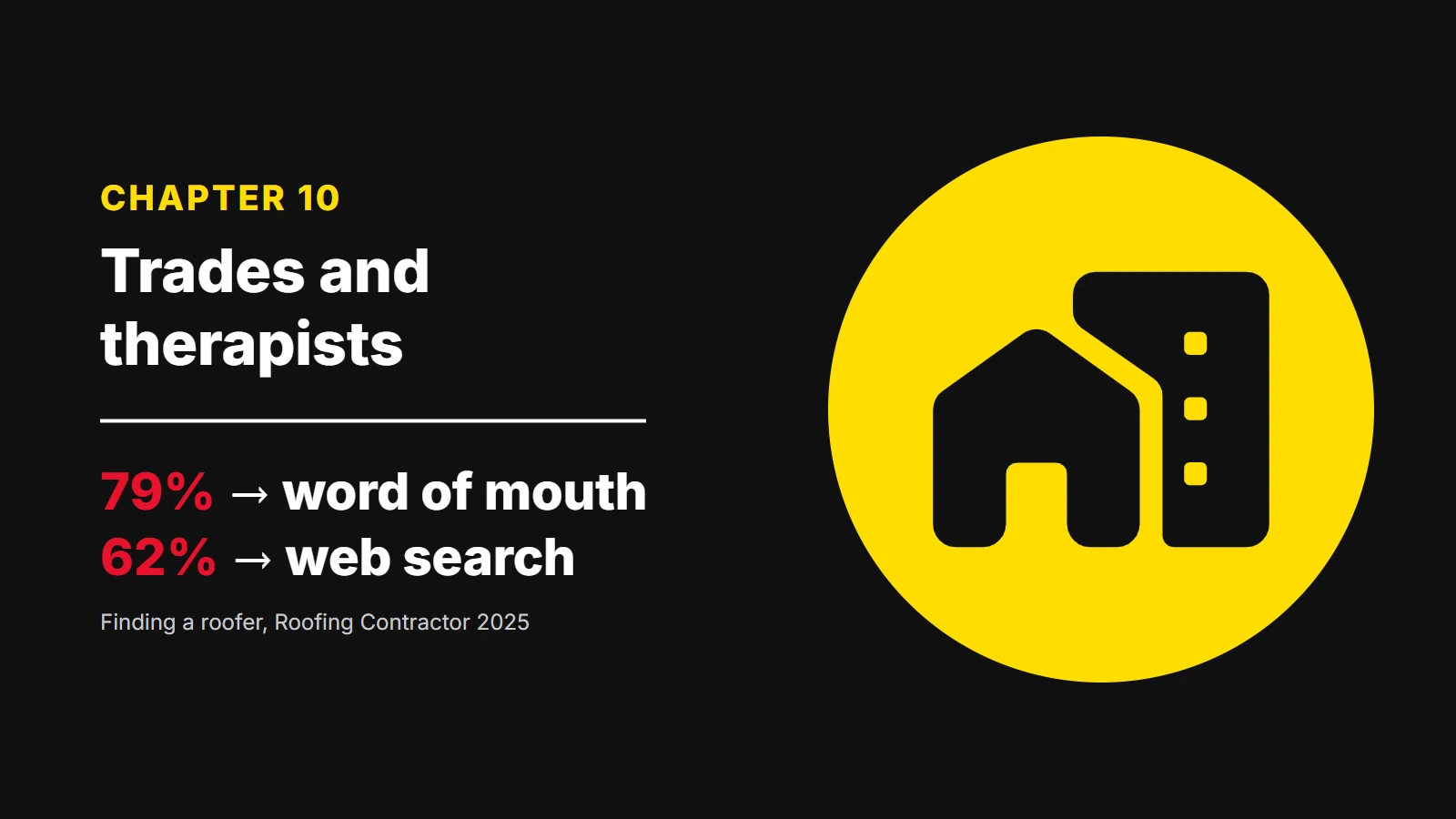
Referrals lead, search closes. In Roofing Contractor's 2025 homeowner survey68, 79% of homeowners said they'd find a roofer through word of mouth, 62% through internet search, 54% by contacting firms they'd used before, and 34% through sites like HomeAdvisor and Angi.
So a referral gets you on the shortlist. Then the homeowner searches your name. What they find, your profile, your reviews and your website, either backs up the referral or undoes it. Chapter 5 and chapter 6 matter more here than any ranking trick.
It's a crowded field. Harvard's Joint Center for Housing Studies describes US remodeling as highly fragmented, with many self-employed contractors and small payroll firms. Replacement projects such as roofing, windows and HVAC made up 49% of homeowner improvement spending in 202369. With many similar firms chasing the same jobs, who answers first often wins.
Intent matters more than page polish. Unbounce found repair and maintenance service pages converted almost three times better than home and renovation pages44. Someone with a leak calls. Someone planning a kitchen compares for weeks. Build separate pages and a different next step for each.
Local Services Ads may apply. See chapter 7. They're changing in 2027, so check what's available for your trade and country.
What trades can do:
- Show your licence number, insurance and real job photos on every service page.
- Answer calls fast, and set up missed-call text-back.
- Show an all-in price or a clear "from" price, including mandatory call-out fees.
- Ask every customer for a review the day the job closes, with a link.
Therapists and psychologists
This industry gets the worst generic advice, so it gets its own section.
Search is one channel among several. In Thriveworks' 2025 survey of 2,000+ US adults in or seeking therapy70, the most-used ways to find a therapist were a primary care doctor (39%), friends and family (32%), insurance company resources (31%), search engines (28%) and online therapist directories like Psychology Today (26%).
Directories matter more here. Yext found healthcare was the industry where listings drove the largest share of AI citations, at 52.6% (vendor).
Don't ask for reviews without checking your regulator. See the warning in chapter 5. In Alberta, Ontario, British Columbia and the US the rules restrict or prohibit it; in Quebec, only unsolicited testimonials are allowed.
Trust signals are the lever. Google's Search Quality Rater Guidelines treat health topics as "Your Money or Your Life" pages, held to a higher standard. The guidelines are what Google's human raters use to judge quality, and raters don't change rankings directly, but the document shows what Google treats as trustworthy. For a therapist's website, that means clear credentials, registration numbers, contact information and who wrote or reviewed the content71.
Testimonials are a real compliance risk. A Canadian study of psychologists' websites found 4.2% displayed client testimonials despite guidelines against them, and 38.9% of those testimonials included potentially identifying information72.
What therapists can do:
- Complete every directory profile, and keep them identical.
- Put credentials, registration and your approach in plain text on your website.
- Publish clear service pages for each issue you treat and each type of session.
- Offer a confidential feedback survey instead of asking for public reviews, where rules require it.
- Reply to public reviews only if your regulator and confidentiality duties allow it, and never confirm someone is a client.
11. Canada, the US and the EU: what differs
Most local SEO advice is written for the US. Here's what changes elsewhere.
| Topic | Canada | United States | European Union |
|---|---|---|---|
| AI use | 46% of internet users used generative AI in the past year3 | 49% of adults use AI chatbots6 | 33% of people aged 16 to 74 used generative AI in the previous three months in 2025; 64% of 16 to 24s, 7% of 65 to 74s5 |
| Review rules | Competition Act and CASL | FTC rule (since 21 October 2024) | Omnibus rules on fake reviews (since 28 May 2022) |
| Privacy | PIPEDA; Quebec Law 25 | State laws vary | GDPR |
| Language | French for Quebec | n/a | Varies by country |
| Accessibility | Not covered in this guide | Not covered in this guide | European Accessibility Act since 28 June 2025 |
| Core listings | Google, Apple Business, Bing Places, Facebook, Yellowpages.ca | Google, Apple, Facebook, Foursquare, Bing, Yelp | Google, Apple, plus national directories (for example PagesJaunes in France, GelbeSeiten in Germany) |
| Buy-local mood | 65% of online shoppers prefer Canadian businesses3 | n/a | n/a |
The EU and Canada comparisons use different time windows (3 months versus 12), so don't put the two AI figures on one chart without noting it.
Where I couldn't find data: There's no EU-specific study measuring how AI assistants source local business information, and no Canadian dataset on whether people check AI answers in Google for local searches specifically. I'd rather tell you than guess.
12. Your 90-Day local SEO plan
If you've read this far, here's the order I'd do it in. You can do all of it yourself.
Days 1 to 30: fix the foundations
- Write your master record (name, address, phone, hours, categories, description).
- Claim and complete your Google Business Profile, Apple Business and Bing Places.
- Audit your hours, phone and address across the web. Fix the wrong ones.
- Set up your review request: one message, one link, sent to everyone.
- Run your first AI visibility audit (chapter 8) and save the results.
Days 31 to 60: fix the website
- Write or rewrite one page per core service, with real details and photos.
- Add a privacy notice next to every form, and shorten the form.
- Run PageSpeed Insights on your top pages and fix the biggest issues.
- Set up your phone and form response routine (chapter 7).
- Link Google Analytics to your Business Profile and tag your profile links.
Days 61 to 90: earn mentions and measure
- Get listed in your trade or professional directory, and your local business association.
- Ask suppliers, partners and local organizations to mention you accurately.
- Reply to all open reviews.
- Run your second AI audit. Compare to the first.
- Write your five-number monthly check into a spreadsheet and start tracking.
Do it yourself or get help?
Do it yourself if you have the time, and it's mostly checklist work. Get help if you don't, if you've been suspended, if your site is slow or broken, or if you're in a regulated profession and aren't sure what you're allowed to do. If you'd like a hand, here's what a website really costs, and here's how I help with local SEO. In the research, time was the barrier owners cited most: among owners without a website, 48% said a lack of time and resources was a major reason52. Spending money isn't the same as buying results. A smaller number of things done well beats a package of everything.
Key takeaways
- Google still holds the majority of local search, about 90% of search engine traffic. AI is a real and growing second channel.
- Most people who use AI for local check somewhere else before acting. The evidence is self-reported and mostly from vendors, so say that when you cite it.
- There's no special AI trick. Google calls optimizing for its AI features still SEO. llms.txt and special schema don't help in Google.
- Your Business Profile is your first website. Accurate name, hours, category and services come first.
- Facts beat claims. Plain, consistent facts on your own site and in your listings are the best protection against AI getting you wrong.
- Mentions on other sites now matter more than piles of directory listings.
- Reviews: 20 or more, around 4.5 stars, recent, answered. Ask everyone, never pay for them, and check your regulator if you're a therapist.
- Speed to respond decides who gets the job.
- Check AI quarterly, and write down what it says.
- Measure what you can, and ask every customer how they found you.
Frequently Asked
Local SEO Questions
Is local SEO still worth it in 2027?
Yes. Google still holds roughly 90% of search engine traffic, and Fishkin's 2026 research notes local businesses are one category where SEO still pays. What's changed is that you now need your information to be right in more places.
Is AI replacing Google for local search?
Not on the evidence available. Surveys show people using AI in addition to search, and most who use AI for local say they check somewhere else before acting. Google is also building AI into search itself, with AI Mode and AI local packs.
What are AEO and GEO, and do I need them?
AEO (answer engine optimization) and GEO (generative engine optimization) are names for being the answer in AI tools. Google says optimizing for its AI features is still SEO. The basics in this guide are what both need.
Do I need an llms.txt file?
Google Search ignores it, so it won't help you rank there. If you want one for other tools, it does no harm. There's a wrinkle, though. Lighthouse, Google's own site-testing tool, now has an llms.txt audit under a new Agentic Browsing category.21 Chrome's documentation says the file helps AI agents understand your site, and marks the audit "not applicable" if you don't have one, because it's optional for now. That isn't a ranking factor. But Google building a test for it makes me wonder if there's more here than Google is letting on.
How many reviews do I need?
In one 2026 US survey, 47% of consumers wouldn't use a business with fewer than 20 reviews, 31% wanted 4.5 stars or higher, and 74% only cared about reviews from the last three months. Treat those as targets, not guarantees.
Can I offer a discount for a review?
No. Google prohibits incentives for reviews, and competition and consumer regulators in Canada, the US and the EU have rules on fake or misleading reviews.
I'm a therapist. Can I ask clients for reviews?
It depends on your regulator. Alberta, Ontario, British Columbia and the American Psychological Association restrict or prohibit soliciting reviews and testimonials. Quebec allows unsolicited ones. Check yours.
Why does ChatGPT show the wrong hours or phone number for my business?
AI tools pull from several sources and don't always get it right. One agency study found about one in five ChatGPT answers about small businesses had incorrect information, and accuracy rose when the business's own website stated facts clearly. Fix your website and listings first.
How do I know if AI is sending me customers?
Partly. Google Analytics now has an AI Assistant channel for ChatGPT, Gemini, Copilot and others. It doesn't include AI Overviews or AI Mode. And an AI answer that names you without a click leaves no trace, so ask new customers how they found you.
What is Apple Business?
It's the free platform that replaced Apple Business Connect in 2026. It controls how your business shows in Apple Maps, Siri and other Apple apps.
Bullshit statistics (imo)
These numbers still show up in "local SEO statistics" roundups, usually with no date and no source.
By bullshit, I mean one of two things:
- It's outdated, but SEO gurus still cite it to hook naive business owners into their overpriced services.
- It's truly just bullshit, and anyone citing it is an idiot who lacks proper research skills.
Here's each one, and which kind it is.
One: outdated, but still being cited
- "76% of people who search on a smartphone for something nearby visit a business within a day." It's from Google material published in 2016.73 That's before AI Overviews, before today's Maps, and before most of this guide existed. Roundups still list it with no date.
- "50% of consumers who did a local search on a smartphone visited a store within a day." From an older Google and Ipsos survey with no date on it. Some of the smartphone questions had bases as small as 94 people.74
- "80% of consumers lose trust if they see inconsistent business details," and "68% would stop using a business with incorrect directory info." From a 2018 US survey of 1,025 consumers.75 It's eight years old, and AI answers weren't part of the picture.
- "ChatGPT is mostly Bing." That's BrightLocal's wording from a 2024 study.76 Neither OpenAI nor Microsoft has said it, and the study came before ChatGPT's Yelp licence and local panels.
Two: just bullshit
- "46% of all Google searches have local intent." One of the most repeated numbers in local SEO. I couldn't find a primary Google publication for it. Roundups attribute it to "Google / GoGulf" and move on.77
- "84% of consumers search for local businesses daily," and "60% click on AI-generated overviews." A vendor press release.78 No published method, no question wording, and it's out of line with every other survey in this guide.
- "Consistent NAP makes you 40% more likely to appear in the local pack," "15 platforms give 23% higher 3-pack odds," "fixing NAP gained 3.2 positions." I couldn't find an original study behind any of them. They exist in blog posts quoting other blog posts.
- "48% of small businesses don't have a website." A misreading. The real figure: among owners who don't have a website, 48% said a lack of time and resources was a major reason.52
- "35% of small businesses have a Google Business Profile and 40% have a website." It comes from a survey of 778 US business owners and managers.79 It's far below official statistics, probably because it includes very small and sole-owner businesses. Not made up, but too weak to build a pitch on.
If a number has no date, no named source, and no sample, don't repeat it. Check the original before you use it, or before you pay anyone who does.
Sources
Superscript numbers in the text link down to these notes. Vendor research is marked as vendor, and US-only samples are marked US.
- Statistics Canada, The Daily, Survey of Digital Technology and Internet Use 2023, 17 September 2024. https://www150.statcan.gc.ca/n1/daily-quotidien/240917/dq240917c-eng.pdf ↩
- Statcounter Global Stats, search engine market share, September 2026. Worldwide, counts search engines only, not chatbots. https://gs.statcounter.com/search-engine-market-share ↩ ↩
- CIRA, 2026 Canadian Internet Trends, full survey results, July 2026. n=2,000 Canadian internet users, fieldwork March to April 2026. https://www.cira.ca/uploads/2026/07/2026-Internet-Trends-by-CIRA_Full-survey-results.pdf ↩ ↩ ↩ ↩ ↩ ↩ ↩
- BrightLocal, Local Consumer Review Survey 2026, February 2026. n=1,002 US adults. Vendor research (US). https://www.brightlocal.com/research/local-consumer-review-survey/ ↩ ↩ ↩ ↩ ↩ ↩ ↩ ↩
- Eurostat, Use of artificial intelligence by individuals, 2025 data. Three-month recall window. https://ec.europa.eu/eurostat/statistics-explained/SEPDF/cache/145512.pdf ↩ ↩ ↩
- Pew Research Center, Americans and AI 2026, 17 June 2026. 5,119 US adults. https://www.pewresearch.org/internet/2026/06/17/americans-and-ai-2026-chatbots-smart-devices-and-views-on-impact/ ↩ ↩
- Near Media, EP 272, The Verification Loop, 2 September 2026. Discusses SOCi's third annual consumer survey (about 1,000 US consumers). Vendor research (US). https://www.nearmedia.co/ep-272-the-verification-loop-how-people-really-find-local-businesses-now/ ↩ ↩ ↩ ↩ ↩
- Yext, 2026 Consumer Search Behaviors Report. 3,848 adults globally who searched for local businesses. Self-reported vendor research. https://www.yext.com/resources/consumer-search-behaviors-full-report ↩ ↩
- Google, Google Search's I/O 2026 updates, 19 May 2026. Company-reported, no method given. https://blog.google/products-and-platforms/products/search/search-io-2026/ ↩
- SparkToro (Rand Fishkin), In 2026, Less than One Third of Google Searches Still Send a Click, 8 June 2026. Similarweb panel, US, January to April 2026. Vendor research. https://sparktoro.com/blog/in-2026-less-than-one-third-of-google-searches-still-send-a-click/ ↩ ↩
- Sterling Sky (Joy Hawkins), AI and Local SEO, 21 September 2026. 179 Business Profiles. Agency research. https://www.sterlingsky.ca/ai-is-quietly-taking-over-local-seo/ ↩
- Pew Research Center, Google users are less likely to click on links when an AI summary appears, 22 July 2025. 900 US adults, March 2025. Google disputed the method. https://www.pewresearch.org/short-reads/2025/07/22/google-users-are-less-likely-to-click-on-links-when-an-ai-summary-appears-in-the-results/ ↩
- Google Search Central, Optimizing your website for generative AI features on Google Search. Published May 2026, updated July 2026. https://developers.google.com/search/docs/fundamentals/ai-optimization-guide ↩ ↩
- Google, Grounding with Google Maps in the Gemini API, 17 October 2025. Describes the developer API, not the consumer Gemini app. https://blog.google/technology/developers/grounding-google-maps-gemini-api/ ↩
- MarTech, Yelp brings reviews and local leads to ChatGPT, 28 July 2026. Trade press; the original announcement could not be opened. https://martech.org/yelp-brings-reviews-and-local-leads-to-chatgpt/ ↩
- Search Engine Roundtable (Barry Schwartz), OpenAI Adds Local Knowledge Panels To ChatGPT Results, 22 December 2025. One observed case, not a statistic. https://www.seroundtable.com/openai-adds-local-knowledge-panel-to-chatgpt-results-40635.html ↩
- Yext, 86% of AI Citations Come from Brand-Managed Sources, 9 October 2025. 6.8 million AI citations. Vendor research, limited method disclosed. https://investors.yext.com/news-events/press-releases/detail/376/yext-research-86-of-ai-citations-come-from-brand-managed ↩ ↩
- Herringbone, Does AI Get Your Business Details Right?, 14 September 2026. 600 small businesses. Agency research, US context. https://herringbone.com/does-ai-get-your-business-details-right/ ↩ ↩
- SOCi, 2026 Local Visibility Index, February 2026. Vendor research on multi-location brands (chains), not independent businesses. https://golocal.soci.ai/rs/355-TUF-572/images/The_2026_Local_Visibility_Index_SOCi100.pdf?version=0 ↩ ↩
- Spearleaf, How ChatGPT Picks a Local Business, August 2026. 12 local services in 18 US cities. Small agency study, descriptive. https://spearleaf.com/research/how-chatgpt-picks-a-local-business/ ↩
- Chrome for Developers, Lighthouse, Agentic browsing: llms.txt audit. Last updated 5 May 2026. Search Engine Journal (Matt G. Southern, 21 September 2026) notes Lighthouse's agent checks and Google Search's guidance look at different things. https://developer.chrome.com/docs/lighthouse/agentic-browsing/llms-txt ↩ ↩
- PPC Land, reporting John Mueller's comment on AI acronyms, 15 August 2025. Secondhand; the original post was not located. https://ppc.land/googles-john-mueller-warns-ai-seo-acronyms-signal-spam-tactics/ ↩
- Google Business Profile Help, Tips to improve your local ranking on Google. https://support.google.com/business/answer/7091 ↩
- Whitespark, Local Search Ranking Factors 2026, 6 November 2025. Survey of 47 local SEO experts scoring 187 factors. Expert opinion, vendor. https://whitespark.ca/local-search-ranking-factors/ ↩ ↩ ↩
- Google Business Profile Help, Guidelines for representing your business on Google. https://support.google.com/business/answer/3038177 ↩
- Google Business Profile Help, Fix a suspended Business Profile. https://support.google.com/business/answer/4569145 ↩
- Google, Ask Maps, 12 March 2026. Launched in the US and India. https://blog.google/products-and-platforms/products/maps/ask-maps-immersive-navigation/ ↩
- Google, Ask Maps expansion (food, hotels and events), 6 August 2026. Rolling out in Canada and 150+ countries and territories in English. https://blog.google/products-and-platforms/products/maps/order-food-in-ask-maps/ ↩
- Whitespark, Top local citation sources, Canada. Undated, vendor. Treat as a starting shortlist, not measured data. https://whitespark.ca/top-local-citation-sources-by-country/canada/ ↩
- Apple Newsroom, Introducing Apple Business, 24 March 2026. https://www.apple.com/newsroom/2026/03/introducing-apple-business-a-new-all-in-one-platform-for-businesses-of-all-sizes/ ↩
- Microsoft Bing Blog, Introducing the new Bing Places for Business, 3 October 2025. https://blogs.bing.com/search/October-2025/Introducing-the-New-Bing-Places-for-Business-Built-for-Business-Owners,-Powered-by-Research ↩
- Han et al., Effect of Negative Online Reviews and Physician Responses on Health Consumers' Choice, Journal of Medical Internet Research 2024;26:e46713. Participants in China, physician setting. https://www.jmir.org/2024/1/e46713/PDF ↩
- Google, Maps user contributed content policy. https://support.google.com/contributionpolicy/answer/7400114 ↩
- Google Business Profile Help, Ask for reviews. https://support.google.com/business/answer/3474122 ↩
- Innovation, Science and Economic Development Canada, Getting consent to send email (CASL). https://fightspam-combattrelepourriel.ised-isde.canada.ca/site/canada-anti-spam-legislation/en/getting-consent-send-email ↩
- Competition Bureau Canada, Online reviews posted by employees: businesses could be liable, 18 January 2024. https://www.canada.ca/en/competition-bureau/news/2024/01/online-reviews-posted-by-employees-businesses-could-be-liable.html ↩
- Competition Bureau Canada, Drip pricing. Updated August 2026. https://competition-bureau.canada.ca/en/node/662 ↩
- US Federal Trade Commission, Consumer Reviews and Testimonials Rule: Questions and Answers. https://www.ftc.gov/business-guidance/resources/consumer-reviews-testimonials-rule-questions-answers ↩
- Your Europe, Unfair and blacklisted commercial practices. Updated 28 April 2026. https://europa.eu/youreurope/citizens/consumers/unfair-treatment/unfair-commercial-practices/index_en.htm ↩
- College of Alberta Psychologists, Practice Guideline: Use of Technology, 1 September 2024. https://www.cap.ab.ca/Portals/0/adam/Content/FUiQGya070-fNPcUnfKjCg/Link/Use%20of%20Technology%20-%20September%201,%202024.pdf ↩
- College of Psychologists and Behaviour Analysts of Ontario, Standards of Professional Conduct, 2024. https://cpbao.ca/members/professional-practice/standards-of-professional-conduct/ ↩
- Ordre des psychologues du Québec, Publicité. Page dated 3 July 2026. https://www.ordrepsy.qc.ca/publicite ↩
- Eurostat, Digital economy and society statistics, enterprises, 2025. Enterprises with 10 or more employees. https://ec.europa.eu/eurostat/statistics-explained/index.php?title=Digital_economy_and_society_statistics_-_enterprises ↩
- Unbounce, Conversion Benchmark Report, commercial and professional services, 2024. Vendor platform data. https://unbounce.com/conversion-benchmark-report/professional-services-conversion-rate/ ↩ ↩
- web.dev, Web Vitals. https://web.dev/articles/vitals ↩
- HTTP Archive, Web Almanac 2025, Performance chapter. July 2025 data, Chrome users only. https://almanac.httparchive.org/en/2025/performance ↩
- Google Search Central, Understanding page experience in Google Search results. Updated September 2026. https://developers.google.com/search/docs/appearance/page-experience ↩
- Deloitte Digital and Google, Milliseconds Make Millions, 2020. Multi-brand study. https://www.thinkwithgoogle.com/_qs/documents/9757/Milliseconds_Make_Millions_report_hQYAbZJ.pdf ↩
- Statcounter Global Stats, desktop vs mobile, Canada, July to September 2026. Share of page views on Statcounter-tracked sites. https://gs.statcounter.com/platform-market-share/desktop-mobile/canada ↩
- Google Search Central, Local Business structured data. Updated September 2026. https://developers.google.com/search/docs/appearance/structured-data/local-business ↩
- Office québécois de la langue française, Langue du commerce et des affaires. https://www.oqlf.gouv.qc.ca/francisation/droits_linguistiques/droits/langue-du-commerce-et-des-affaires.html ↩
- Small Business Majority, Digital Transformation: Small Businesses Face Obstacles, Opportunities in Growing Their Online Presence, 2023. n=871, US. Leans toward very small firms. https://smallbusinessmajority.org/sites/default/files/research-reports/small-businesses-face-obstacles-opportunities-growing-online-presence.pdf ↩ ↩
- Oldroyd and InsideSales.com (MIT Sloan), Lead Response Management Study, 2007. Six companies, 15,000+ leads, 100,000+ call attempts. https://www.onecavo.com/wp-content/uploads/2015/11/MIT-InsideSales.com_Lead-Response-Management.pdf ↩
- NSW Government Behavioural Insights Unit, Using behavioural insights to increase completion of forms and surveys, 2020. https://www.nsw.gov.au/sites/default/files/2021-08/how-to-increase-form-and-survey-completion.pdf ↩
- MECLABS, Optimizing Web Forms, test ID TP1636, c. 2014. A presentation deck. https://www.slideshare.net/slideshow/web-forms-clinic-v9-eh/34721661 ↩
- Kohavi, Henne and Sommerfield, Practical Guide to Controlled Experiments on the Web, KDD 2007. http://ai.stanford.edu/~ronnyk/2007GuideControlledExperiments.pdf ↩ ↩
- Kohavi et al., Online Controlled Experiments at Large Scale, KDD 2013. https://www.exp-platform.com/Documents/2013%20controlledExperimentsAtScale.pdf ↩
- Google Ads Help, Local Services Ads transition to Performance Max campaigns with pay-per-lead goals. https://support.google.com/google-ads/answer/17213585 ↩
- WordStream by LocaliQ, Google Ads Benchmarks 2025. 16,000+ US campaigns. Vendor research. https://www.wordstream.com/blog/2025-google-ads-benchmarks ↩
- Google Business Profile Help, Understand your Business Profile performance. https://support.google.com/business/answer/9918094 ↩
- Google Analytics Help, Default channel group definitions. https://support.google.com/analytics/answer/9756891 ↩
- OpenAI Help Center, Publishers and Developers FAQ. "ChatGPT automatically includes the UTM parameter utm_source=chatgpt.com in referral URLs." Read 7 October 2026. https://help.openai.com/en/articles/12627856-publishers-and-developers-faq ↩
- Google Search Central Blog, Search Generative AI performance reports in Search Console, 3 June 2026. https://developers.google.com/search/blog/2026/06/gen-ai-performance-reports ↩
- Google Analytics Help, What's new in Google Analytics (release notes). https://support.google.com/analytics/answer/9164320 ↩
- BrightLocal (Claire Carlile), Google Business Profile UTM tracking. Undated, around 2022. Vendor guidance. https://www.brightlocal.com/learn/google-business-profile/reporting/google-business-profile-utm-tracking/ ↩
- Google Analytics Help, Manual tagging and auto-tagging (UTM parameters). https://support.google.com/analytics/answer/10917952 ↩
- Near Media, EP 275, Rankings Up, Calls Down, 24 September 2026. A podcast summary, not the study itself. https://www.nearmedia.co/ep-275-rankings-up-calls-down-what-ai-visibility-is-really-worth-to-local-businesses-part-2/ ↩
- Roofing Contractor, 2025 Homeowner Roofing Survey. US, trade publication, sample size not stated in the excerpt reviewed. https://www.roofingcontractor.com/articles/100649-2025-homeowner-roofing-survey-tracking-the-journey ↩
- Harvard Joint Center for Housing Studies, Improving America's Housing 2025. https://www.jchs.harvard.edu/sites/default/files/interactive-item/files/Harvard_JCHS_Improving_Americas_Housing_2025_Press_Release.pdf ↩
- Thriveworks, How consumers find therapists in 2025. 2,000+ US adults, multiple answers allowed. Vendor research (US). https://thriveworks.com/help-with/research/therapy-seeking-decisions-2025 ↩
- Google Search Quality Rater Guidelines. https://static.googleusercontent.com/media/guidelines.raterhub.com//en/searchqualityevaluatorguidelines.pdf ↩
- University of New Brunswick, Scope and Ethics of Psychologists' Use of Client Testimonials on Professional Websites, c. 2017. Older data. https://unbscholar.lib.unb.ca/bitstreams/554c47b2-a7ac-42af-bcb9-5ef88558a9f3/download ↩
- Think with Google, Mobile search trends that are driving consumers to stores, November 2016. https://www.thinkwithgoogle.com/_qs/documents/620/mobile-search-trends-consumers-to-stores.pdf
- Think with Google and Ipsos, How advertisers can extend their relevance with search. Undated; some smartphone questions have bases of 94 to 214. https://www.thinkwithgoogle.com/_qs/documents/2940/how-advertisers-can-extend-their-relevance_yaSNdcu.pdf
- BrightLocal, Local Citations Trust Report, 27 March 2018. 1,025 US consumers. Vendor research. https://www.brightlocal.com/research/local-citations-trust-report/
- BrightLocal, Uncovering ChatGPT Search Sources, 12 December 2024. 800 US searches run in November 2024. Vendor research. https://www.brightlocal.com/research/uncovering-chatgpt-search-sources/
- Searchlab, Local SEO Statistics 2026. An example of a roundup repeating the claim with no primary source. https://searchlab.nl/en/statistics/local-seo-statistics-2026
- Rio SEO (Press Ganey Forsta), fifth annual Local Search Consumer Behavior Study, press release via Business Wire, 21 May 2025. Method and question wording not published. https://www.businesswire.com/news/home/20250521597796/en/AI-Accuracy-and-Reputation-Whats-Driving-Online-Local-Search-in-2025
- BrightLocal, SMB Marketing Report 2025, 7 August 2025. n=778 US small business owners and managers. Vendor research. https://www.brightlocal.com/research/smb-marketing-2025/