Open for playtesting
You Suck
at Living
Write » Beg » Survive
A dark comedy survival game about a copywriter on the streets of Toronto. You sit on a sheet of cardboard with a typewriter, a bucket and a paper cup, and write poems for strangers to get through four weeks. This guide explains how a day works, where the money comes from, what the CCMP wants from you and what can go wrong.
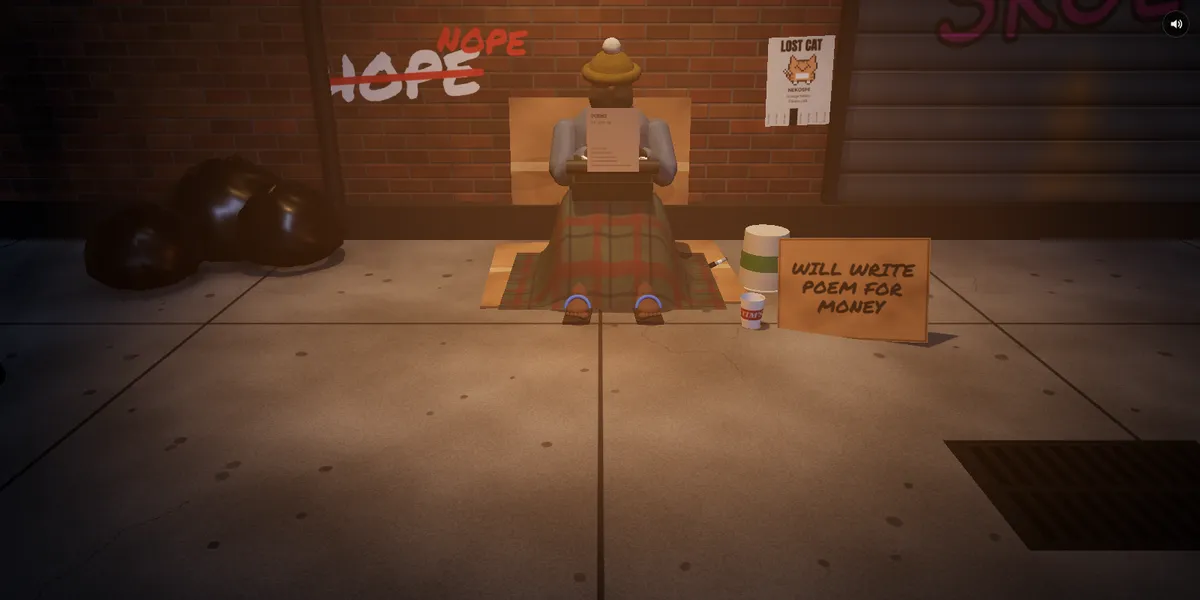
It runs in the browser on a computer with a keyboard. Phones and tablets can open the site, but the game itself is desktop only for now. 18+ only: violence, drugs and strong language.
The inspiration
Why I made it
My first paid writing gig, ten years ago, paid $12 for a 400-word article. Copywriting paid my way for the decade after that. Then AI learned to write, and the work that used to go to writers started going to software.
You Suck at Living is the dark comedy version of that story. You play a copywriter whose clients replaced him with AI. His savings are gone, so he flies home to Toronto with a typewriter, a bucket and his brains, and has to survive on the street by writing poems for whoever stops.
The game launched on October 1, 2026, ten years after that first $12 gig.
Until October 31
The poetry contest
Poetry contest, October 1–31
Every poem you write in the game is kept, sold or not. Sign in with your email (we send a link, there's no password) to save your poems online, make them public and pick one as your contest entry.
Your best poem could win $100 CAD.
Public poems are checked before they appear on the Community page. You pick one poem as your entry.
How it plays
A day on the street
Each day starts at sunrise, about 7:15 AM in early October and a little later every day. Twelve hours pass in about five real minutes.
- Day 1 opens with the CCMP. An officer walks up and warns you about busking and begging without a permit. How you answer matters. Before he leaves, he gives you a wool blanket.
- Work the corner. Pick what he does (sit, hold up a sign, beg, sing, play an instrument, or write poems) and his mood. The street is quiet in the morning, busy at lunch (11:30 to 1:30), slow in the afternoon and busy again from 4 to 6, when people leave work.
- Watch the weather and the light. It gets colder after dark, and the colder it is the faster Warmth drains. The typewriter can't be used in the rain.
- Call it a night. The button unlocks at 9 PM. Stay out later if you want, but at 1 AM the day ends anyway.
- Spend it at night. Food, the convenience store, the army surplus store, lessons, and where to sleep. Then the next morning starts.
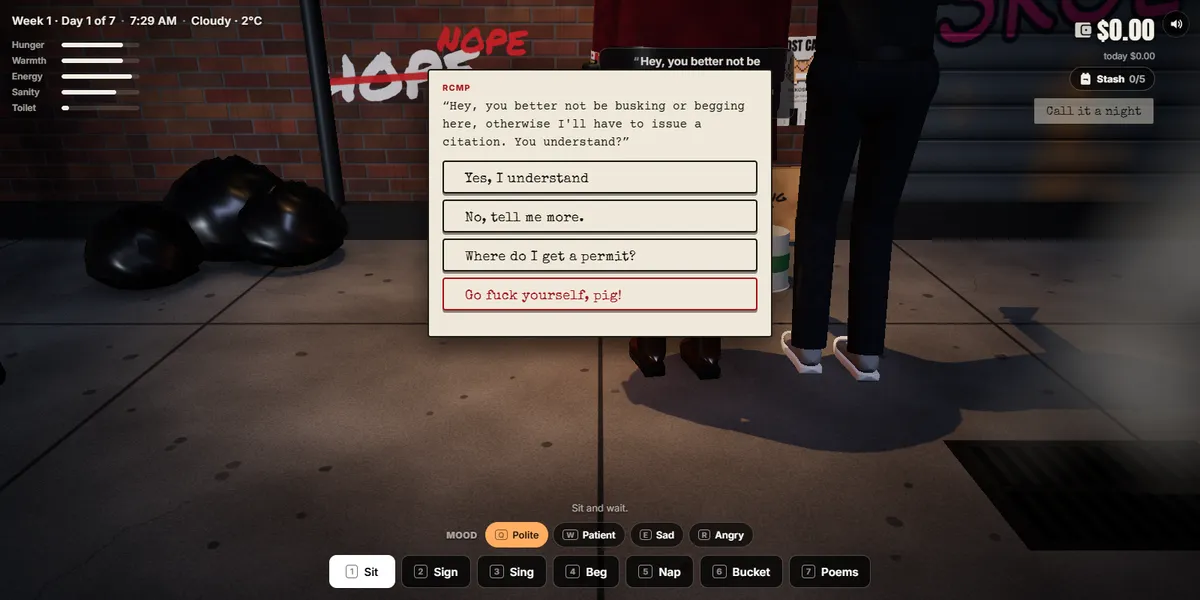
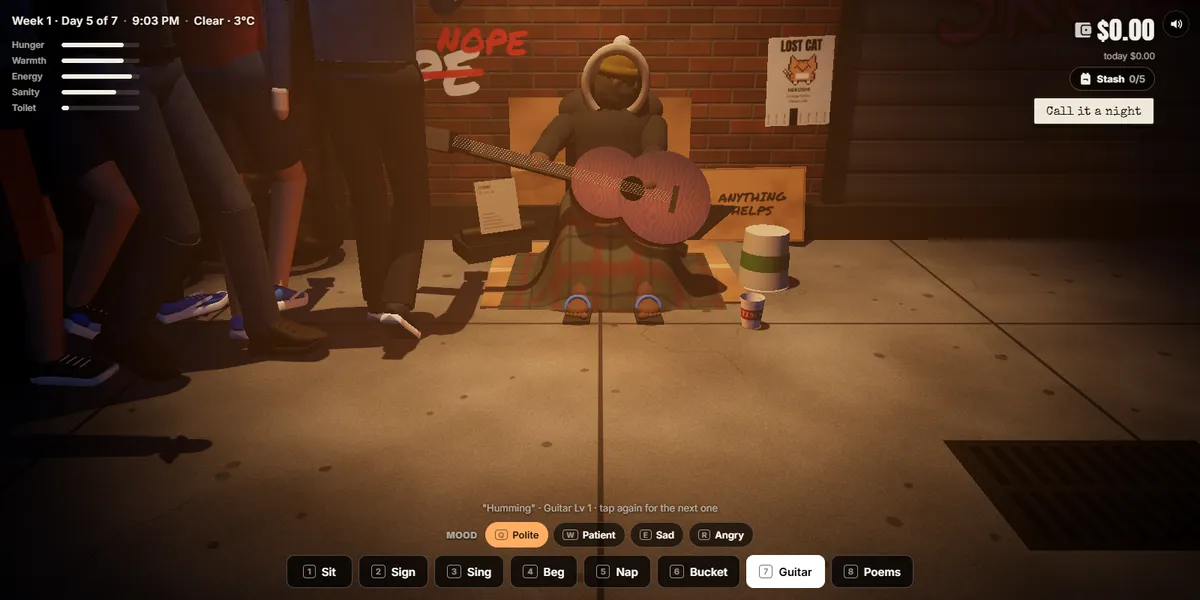
The first day has a short tutorial. It walks you through moods with a dog, then the typewriter, and only lets you write poems until your first one sells. Skip it any time.
Earning
Making money
Money lands in the cup. Coins clink, and a good customer drops a bill.
Poems
The best earner by far. Set up the typewriter, and people stop to ask for a poem with their words. You write it yourself.
Music
Sing, drum on the bucket, or play a harmonica, flute or guitar from the Surplus. An unpractised voice mostly gets winces. Play all day or practise at night to level up to 3, and each level sounds better and pays more.
Signs
You start with ANYTHING HELPS. A black marker ($2) lets you write new ones, including WILL WRITE POEM FOR MONEY, which brings poem customers. Each sign works better on some people than others.
Begging
Ask for change. It pays a little more than sitting, but more people turn nasty, and the CCMP moves you on.
The heart of the game
Writing poems
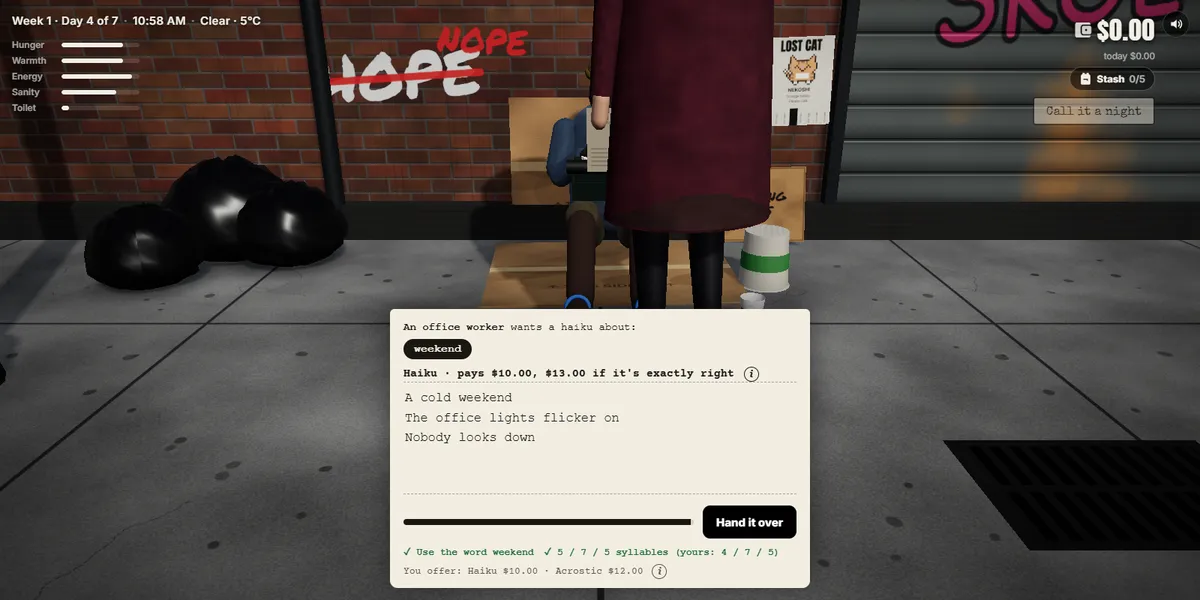
A customer gives you their words. Write them a poem with every word, spelled exactly, in at least two lines and eight words of real sentences, then hand it over. A checklist under the poem ticks off as you type.
How they judge it
- Only gibberish sends a customer away. A poem that misses a word or runs short can still sell, but they're less likely to buy it and pay less.
- Only the exact word counts: "trains" won't do for "train". They'll tell you as they leave.
- Rhymes, four lines or more, more words and fewer repeats all pay more.
- The night menu's Your poems shows every poem, what it paid and why.
It gets harder
- Your first three poems use two words, then three, four and five as you sell more.
- Week 1 words are everyday ones. Week 2 adds words that are hard to rhyme, week 3 long unpoetic ones, week 4 Toronto and Canada.
- From week 2, picky customers ask for something extra: in this order, make it rhyme, or don't use a certain word. Do it and they pay half again.
| Poems sold | Words to use | Pays |
|---|---|---|
| First 3 | 2 | $1 to $8 |
| 4 to 8 | 3 | $2 to $12 |
| 9 to 15 | 4 | $4 to $20 |
| 16 and up | 5 | $6 to $30 |
Kinds of poems you can learn
The Learn tab at night teaches poem forms, the way it teaches songs. Once you know one, some customers ask for it and pay its set price when the poem fits the form, plus 30% when it's exactly right. The harder forms open up later in the month.
| Form | The rules | To learn | Pays | From |
|---|---|---|---|---|
| Haiku | Three lines: five syllables, then seven, then five. | $15 | $10 | Week 1 |
| Acrostic | One line for each letter of the customer's name, so the first letters spell it down the side. "Hi, I'm Stacey. I want a poem with my name in it." | $20 | $12 | Week 1 |
| Limerick | Five lines. Lines 1, 2 and 5 rhyme; lines 3 and 4 are shorter and rhyme with each other. | $30 | $16 | Week 2 |
| Cinquain | Five lines of two, four, six, eight and two syllables. | $35 | $18 | Week 2 |
| Sonnet | Fourteen lines of iambic pentameter: about ten syllables a line, da-DUM five times. The last two lines rhyme. | $60 | $40 | Week 3 |
Hungover, the words you're given are missing letters. It's worst first thing in the morning and gone by evening.
Q W E R
Moods
His mood changes who gives, who turns nasty and how much it hurts.
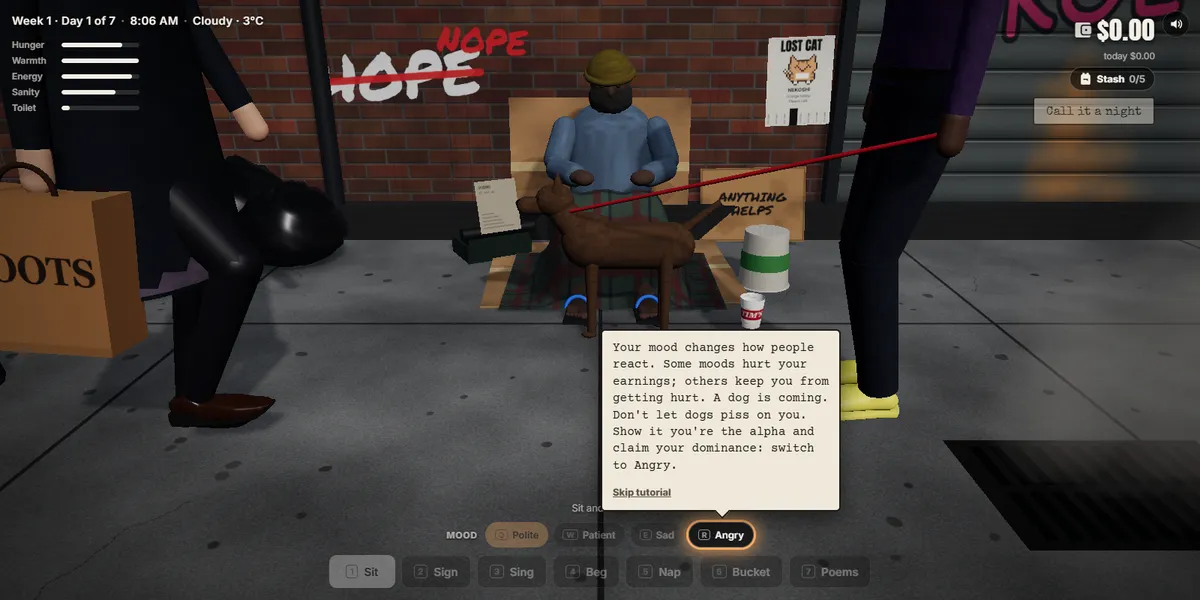
| Mood | What it does |
|---|---|
| Polite | Says thank you when people give, nothing else. The safe default. |
| Patient | Sits quietly and waits. Sanity drops slower, but people give a little less. |
| Sad | Cries and begs. Grannies, office workers and tourists feel sorry for you; everyone else gives less, and insults hurt more. |
| Angry | Yells at people. Most people hate it and give less. It's the only mood that scares off dogs, thieves and the gang kid, but anyone he yells at may call the CCMP. |
Stay alive
The five bars
If Hunger, Warmth, Energy or Sanity runs out, it's over. At night a red line warns you when a bar won't make it to morning.
| Bar | Goes down from | Comes back from |
|---|---|---|
| Hunger | Time, and playing music | Food at night, from a dumpster to a steakhouse |
| Warmth | Cold, rain, snow and sleeping outside; faster after dark | Clothes, a sleeping bag, drinks, a roof |
| Energy | Everything you do | Napping, sleeping, coffee |
| Sanity | Time, insults, spit, rejections, theft | Sales, kind people, meditating, a better bed |
| Toilet | Fills up with time, food and drink | A coffee shop washroom ($2) or a bed indoors. At 100 he goes where he sits. |
Clothes from the Surplus show on him and slow the cold: a parka (30% slower), boots and a toque (15% each), gloves and wool socks (10% each), and a poncho in the rain.
The Canadian police
The CCMP
From Day 2, an officer stops you once a day if you beg, or play music without a permit.
At a stop
Say sorry, show a permit, or slip him money. $5 gets you laughed at, $20 works three times in ten, $50 half the time. After he refuses one, don't try again.
Permits
The real one costs $55.91 and a whole day in line at City Hall. The Surplus sells a forged one for $40; one officer in four spots it.
Fines
Citations cost $50, then $100, then $150. Pay them at night. Leave them unpaid and the next stop takes your typewriter, bucket, cart and instruments, and you spend the next day in court. The judge gives the typewriter back. The rest is gone.
Complaints
Yell at a dog's owner or a passer-by and they may call it in. Each call brings an officer with a warning. The third warning is a night in jail.
Toronto
What can go wrong
| What | From | What happens |
|---|---|---|
| Dog walkers | Day 2 | A dog pees on your spot unless you shoo it, and you can only shoo it when you're Angry (Space). A soiled spot earns less until you buy fresh cardboard. |
| The thief | Day 3 | Once there's $3 in the cup, he may take the day's money. More likely while you nap. An angry mood or a dog scares him off. |
| The gang kid | Day 3, mostly after school | He hangs around your typewriter. Get angry and he backs off. If he grabs it, type the words on screen fast enough to keep it. Lose it and a used one turns up at the Surplus the next day, for more every time. |
| Kids at night | Day 3 | Sleeping outside without a shopping cart, one loose item may be gone by morning. Never the typewriter. |
| Rust | Wet nights | An uncovered typewriter rusts. Past 30% some keys stop working; at 100% it never types again. A cover or tarp stops it. |
| Food poisoning | Dumpster diving | Three times in ten. Food makes it worse until you buy medicine. |
| Odd requests | Day 2 | Now and then someone stops with something that isn't a poem. Some offers are worth refusing. |
After dark
The night menu
Spend what you made. Tomorrow's forecast is at the top, so you can shop for it. The weather radio ($15) gives the exact odds and timing of rain.
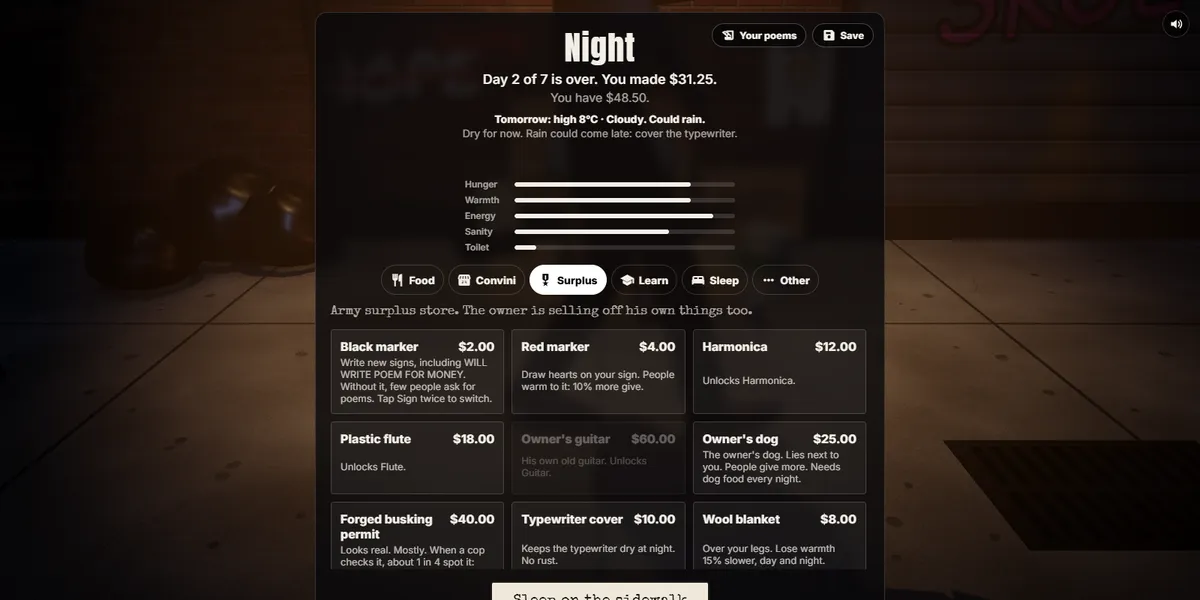
Food
A dumpster dive or the soup kitchen for free, up to a steakhouse that brings Sanity all the way back.
Convini
Coffee, beer, wine, whiskey, cat food, stomach medicine, scratch tickets and Lotto 6/69. Drinks warm you up and calm you down, then you wake up hungover. Drinking every night catches up with you.
Surplus
Markers, instruments, the owner's guitar and his dog, clothes, a typewriter cover, a tarp, a sleeping bag, rations, a duffel bag, and a shopping cart nobody will miss.
Learn
Practise your voice and instruments, and learn new kinds of poems.
Sleep
The sidewalk is free. A shelter bed, motel or hotel costs more and does more.
Other
The washroom, meditating, therapy, paying your fines, a permit from City Hall, and a one-way ticket out.
Your stash holds five things. A duffel bag adds five more, a cart seven.
Four weeks
Weeks, saves and endings
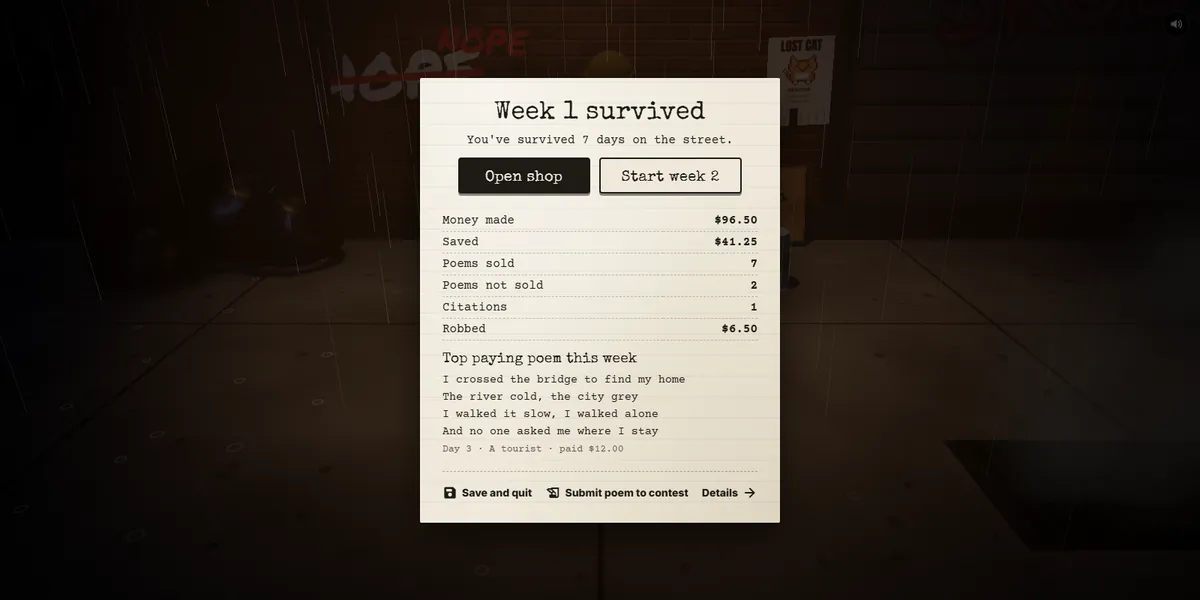
Survive seven days and the week ends on a summary: what you made, what you saved, and the top paying poem of the week. Then you open the shop or start the next week, keeping everything you own.
Saving
The game saves in your browser every morning, and when you tap Save at night. Continue from the title screen.
Endings
Thirteen of them, good and bad. The Endings screen keeps the ones you've found and gives you a hint for each one you haven't.
Keyboard and mouse
Controls
Letters from a Copywriter
Honest letters on words, selling, and staying human in the AI era.
All letters are written by my human hands. You can unsubscribe anytime.